
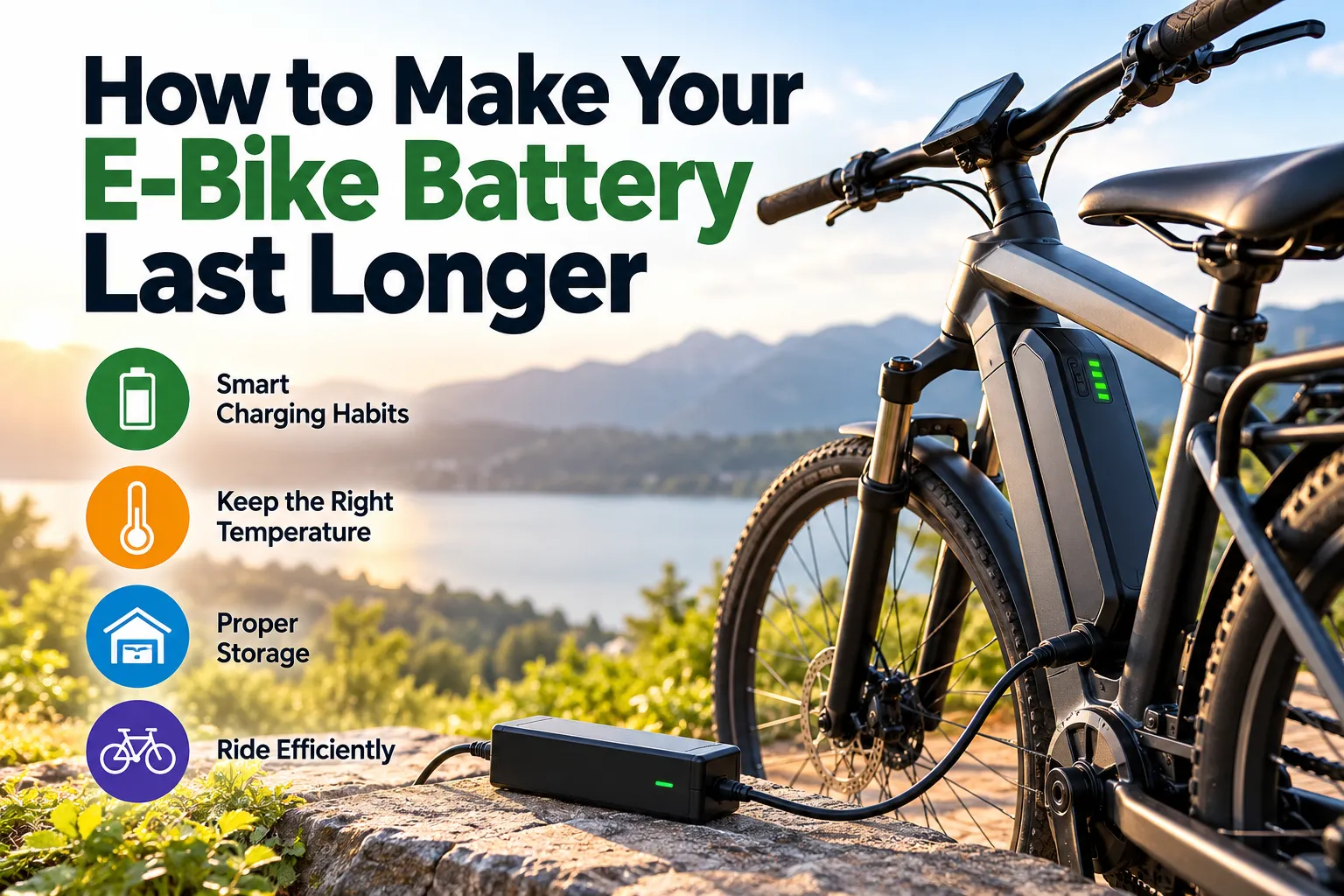
Your e-bike battery won’t maintain its original capacity forever, but the way you charge, store, and use it can influence how quickly it ages. A few practical habits can help you preserve battery health, avoid unnecessary stress, and get more useful years from your investment.
The most important steps are straightforward: follow your manufacturer’s charging instructions, avoid unnecessary exposure to extreme temperatures, don’t routinely run the battery completely empty, and use sensible charging and storage habits. You don’t need to follow complicated rituals or obsess over every percentage point.
Here’s how to make your e-bike battery last longer without sacrificing the convenience that made you buy an electric bike in the first place.
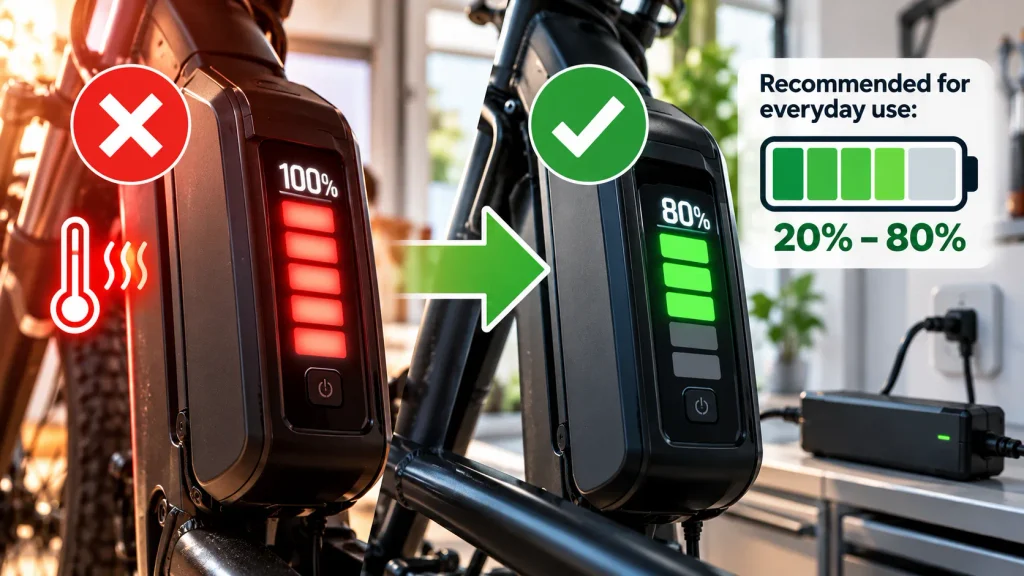
1. Avoid Keeping Your Battery at 100% All the Time
One of the most useful battery-care habits is understanding the relationship between state of charge and battery aging.
Most modern e-bikes use lithium-ion batteries. These batteries gradually lose capacity through normal aging, even when they’re not being used. However, spending extended periods at a very high state of charge can accelerate aging in many lithium-ion battery designs, particularly when combined with high temperatures.
That doesn’t mean charging to 100% is inherently bad.
If you need the full range for a long commute, a delivery shift, or a weekend ride, charging fully may be the right decision. The more important distinction is between charging to 100% when you need it and leaving a fully charged battery sitting unused for extended periods.
Should you follow the 20–80% rule?
The commonly discussed 20–80% charging range is a useful guideline for some lithium-ion batteries, but it isn’t a universal requirement for every e-bike.
| Charging habit | Practical approach |
|---|---|
| Everyday short rides | Consider a moderate charge level if your manufacturer permits it |
| Long-distance rides | Charge to 100% when the extra range is useful |
| Battery at a low charge | Recharge rather than routinely running it completely empty |
| Fully charged but unused | Avoid leaving it at 100% for prolonged periods when practical |
| Manufacturer specifies a different procedure | Follow the manufacturer’s instructions |
The trade-off is simple: a lower charge level may be better for long-term battery health in some circumstances, but it also means less range immediately available.
Choose a charging routine that fits your actual riding needs rather than treating a particular percentage as a strict rule.
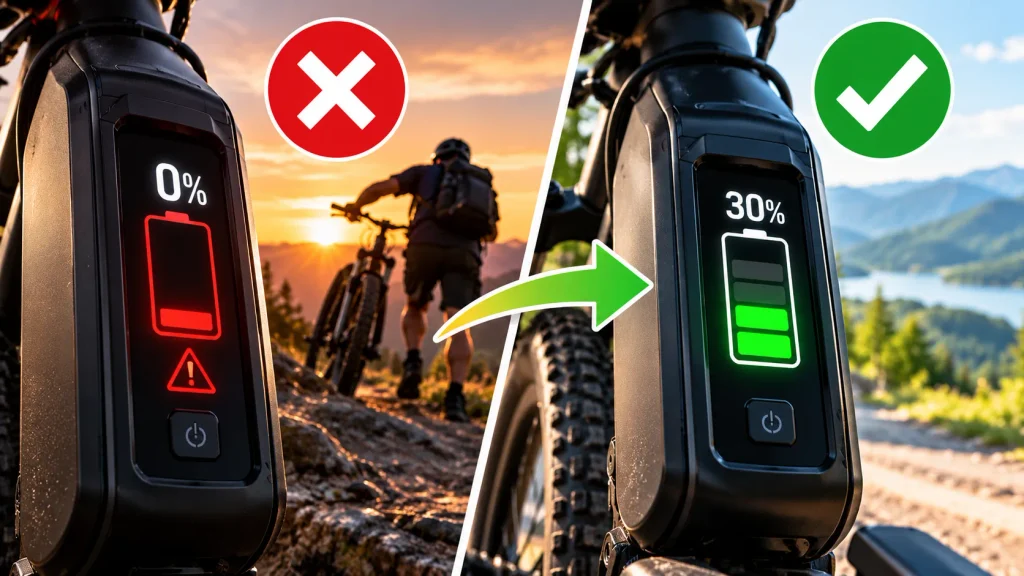
2. Don’t Routinely Drain the Battery Completely
Running your e-bike battery down to zero before recharging isn’t a good everyday strategy.
Lithium-ion batteries generally experience less stress when they’re not repeatedly taken to very low states of charge. Although the bike’s battery management system (BMS) is designed to help protect the battery, its protective cutoff isn’t a target you should aim for on every ride.
Instead, recharge when convenient, especially if your battery is getting low.
For example, if your commute uses a substantial portion of your battery capacity, charging after the ride is generally more sensible than deliberately taking another trip just to drain the remaining charge.
A few practical habits help:
- Recharge before the battery reaches an extremely low state of charge.
- Avoid leaving a nearly empty battery unused for weeks or months.
- Don’t repeatedly use the motor at maximum assistance simply to test the battery’s limits.
- Pay attention to your bike’s battery indicator, while remembering that displayed percentages are estimates rather than precise measurements.
One important distinction: occasional low-battery rides are not the same as routinely deep-discharging the pack. The goal is to avoid making extreme discharge a habit.
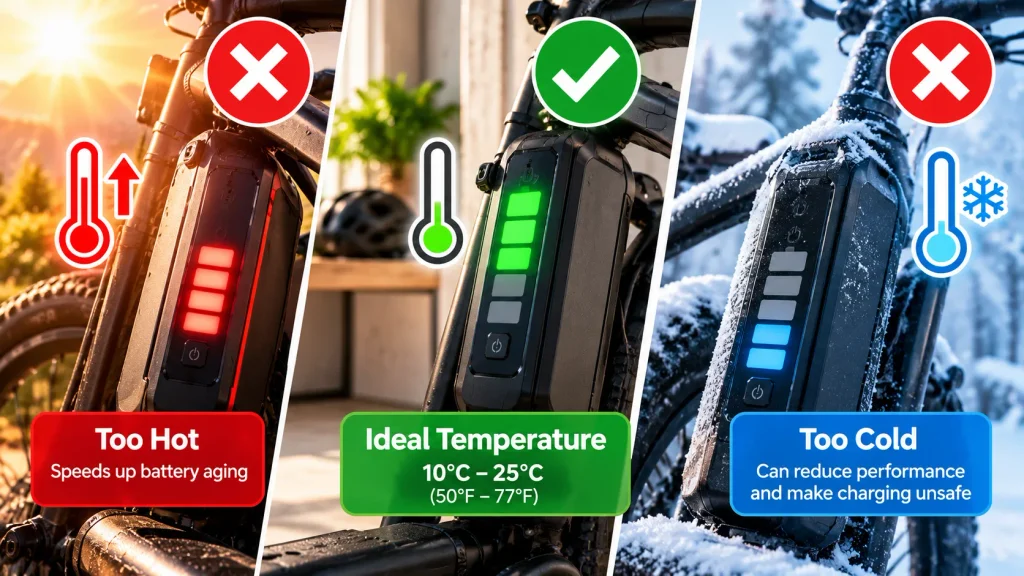
3. Keep Battery Temperature Under Control
Temperature is one of the most important factors in lithium-ion battery aging.
Both high and low temperatures can affect battery performance, but they create different problems. Heat can accelerate long-term degradation, while charging a cold lithium-ion battery outside its permitted temperature range can cause damage.
Protect your battery from heat
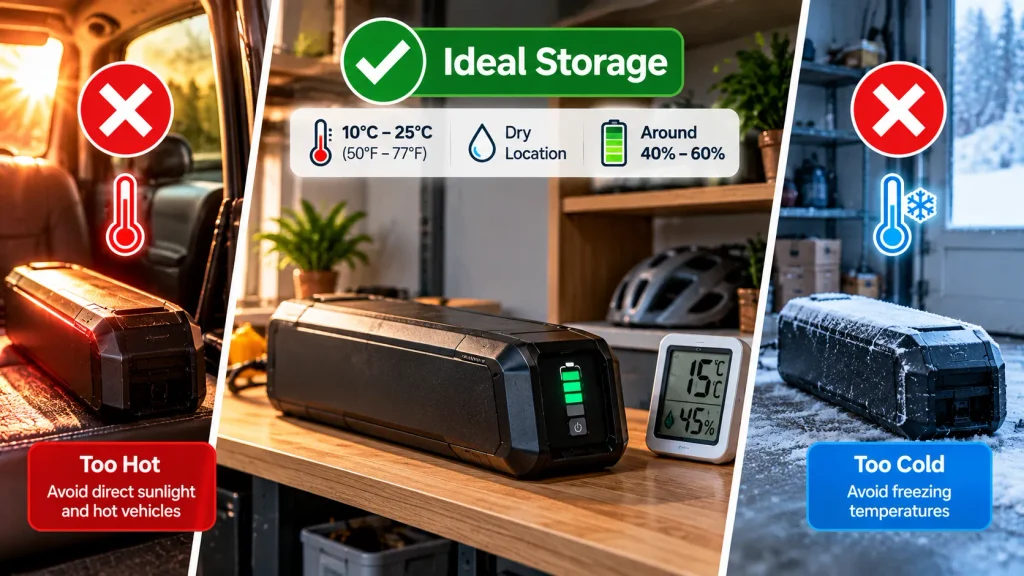
Avoid leaving your battery in direct sunlight for extended periods, storing it in a hot vehicle, or charging it in an excessively hot environment.
A battery may become warm during use or charging, but unusual or excessive heat deserves attention.
Practical steps include:
- Store the battery in a cool, dry location within the manufacturer’s specified temperature range.
- Keep it away from radiators and other heat sources.
- Avoid charging immediately after a demanding ride if the battery is still excessively hot.
- Follow the manufacturer’s guidance on cooling and charging.
Be careful when charging in cold weather
Cold weather can reduce the range available during a ride, sometimes noticeably. That doesn’t necessarily mean the battery has permanently lost capacity.
If your battery has been exposed to freezing temperatures, allow it to return to the manufacturer’s permitted charging temperature before connecting the charger. Don’t assume that a battery safe to discharge in cold weather is also safe to charge at the same temperature.
The exact permitted temperatures depend on the battery design, so consult your owner’s manual rather than relying on a single temperature rule for all e-bikes.
4. Use the Correct Charger
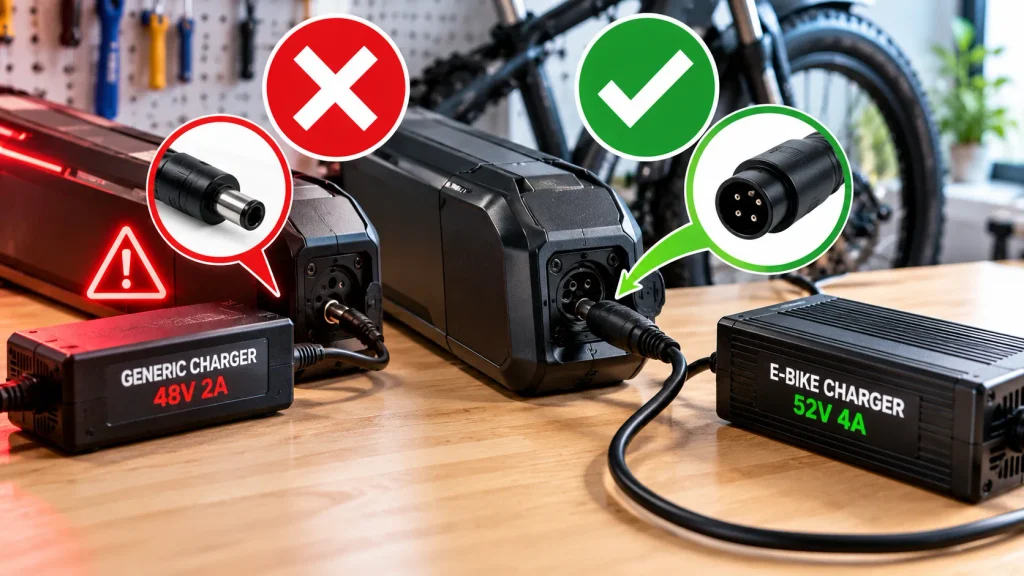
A compatible charger is essential for safe and reliable battery operation.
The charger must match the battery’s required charging voltage and be suitable for its charging system. A plug that physically fits does not establish electrical compatibility.
Using an incorrect charger can damage the battery or create a safety hazard.
Follow these rules:
- Use the original charger or a replacement explicitly approved for your battery model.
- Check the charger’s output voltage and compatibility requirements.
- Inspect the cable, connector, and charging port for visible damage.
- Avoid using damaged chargers or improvised adapters.
- Follow the manufacturer’s instructions for charging and disconnecting the battery.
If your original charger fails, don’t select a replacement based solely on connector shape, advertised wattage, or the battery’s nominal voltage.
The correct charger is part of the battery system, not just an accessory.
5. Store Your E-Bike Battery Properly
How you store your battery matters, especially during winter or any period when you won’t be riding for several weeks.
Leaving a battery fully charged in a hot garage is not ideal. Neither is storing it nearly empty for an extended period.
For many lithium-ion e-bike batteries, a moderate state of charge is appropriate for longer storage, but the manufacturer’s recommended storage level takes priority.
A simple long-term storage routine
- Choose a suitable location. Keep the battery in a dry, temperature-controlled environment within its permitted storage range.
- Avoid extreme charge levels. Use the storage charge level specified by the manufacturer.
- Check the battery periodically. Batteries can slowly lose charge while sitting unused.
- Recharge when needed. If the charge falls below the manufacturer’s recommended storage threshold, follow its guidance.
- Protect the battery from physical damage. Avoid dropping it, crushing it, or storing it where its terminals can contact metal objects.
If your bike has a removable battery, storing it separately may be practical, provided the manufacturer allows it and the battery is kept in a suitable environment.
Don’t assume that a battery can be stored indefinitely without attention. Self-discharge and the battery management system’s own power consumption can gradually reduce its charge.
6. Understand What Your Battery Management System Does
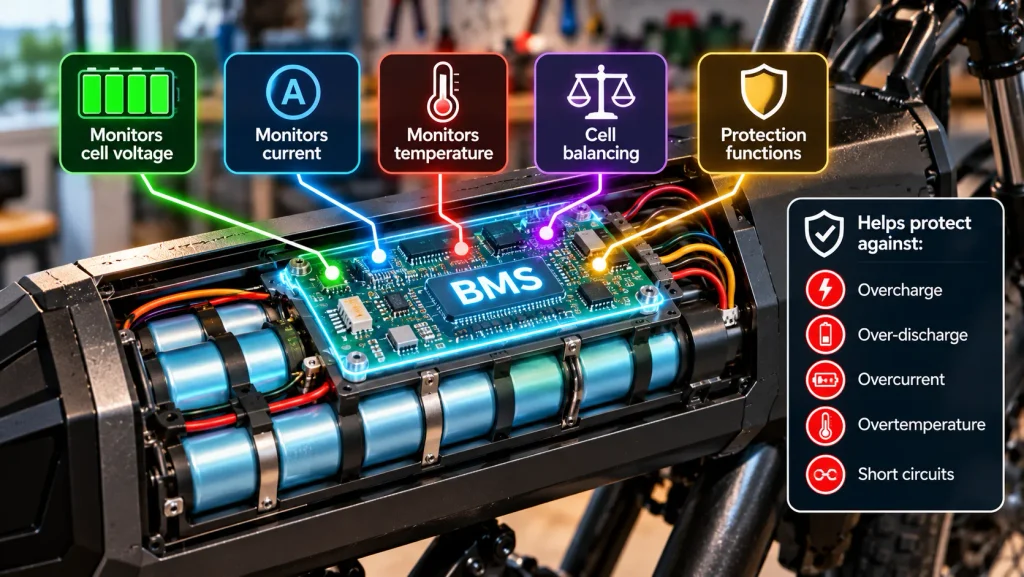
The battery management system, commonly called the BMS, monitors and helps protect the battery pack.
Depending on the design, it may monitor cell voltages, current, temperature, and other operating conditions. It may also provide protection against certain unsafe operating conditions and manage cell balancing.
But the BMS isn’t a substitute for good battery-care habits.
It doesn’t make excessive heat harmless, turn an incompatible charger into a safe one, or eliminate normal battery aging.
What about cell balancing?
A lithium-ion battery pack contains multiple cells connected in groups. Over time, differences between cells can affect how the pack charges and discharges.
Some BMS designs balance cells under particular conditions, and the balancing process may depend on the pack’s design and charging behavior.
This is why charging instructions can differ between e-bike models. One manufacturer may specify a particular charging procedure for balancing or maintenance, while another may use a different approach.
Don’t assume that every battery needs to remain connected to its charger overnight or reach 100% on a fixed schedule. Follow the procedure intended for your particular battery.
If you’re interested in the relationship between charging behavior, battery management, and long-term battery health, these are exactly the kinds of details worth understanding rather than relying on generic rules.
7. Reduce Unnecessary Battery Stress While Riding
Your riding style also influences how much energy your e-bike consumes.
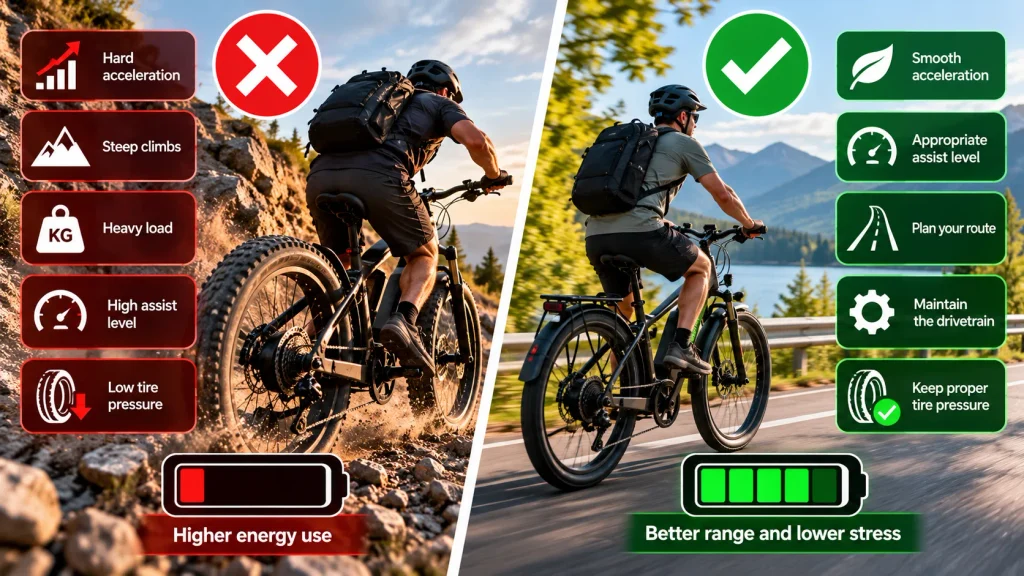
Frequent hard acceleration, sustained high assistance, steep climbs, heavy cargo loads, and low tire pressure can all increase energy demand. Higher current draw can also increase electrical and thermal stress, depending on the battery and system design.
You don’t need to ride slowly everywhere. The goal is to avoid unnecessary energy consumption when it doesn’t improve the ride.
Practical ways to improve battery use
- Accelerate smoothly. Avoid repeated full-throttle starts when a gentler acceleration is sufficient.
- Choose the appropriate assistance level. Use higher assistance when you need it, but don’t default to maximum power on every flat section.
- Keep your tires properly inflated. Follow the tire manufacturer’s recommended pressure range for your load and riding conditions.
- Maintain the drivetrain. A clean, properly lubricated chain and a well-adjusted drivetrain help reduce unnecessary mechanical losses.
- Plan your route. Avoiding unnecessary detours and repeated steep climbs can reduce energy consumption.
- Account for cargo and terrain. Carrying heavy loads uphill generally requires more energy than riding on level ground without cargo.
These changes can help you get more distance from a charge. They don’t reverse battery aging, but they can reduce how often you need to recharge for the same riding routine.
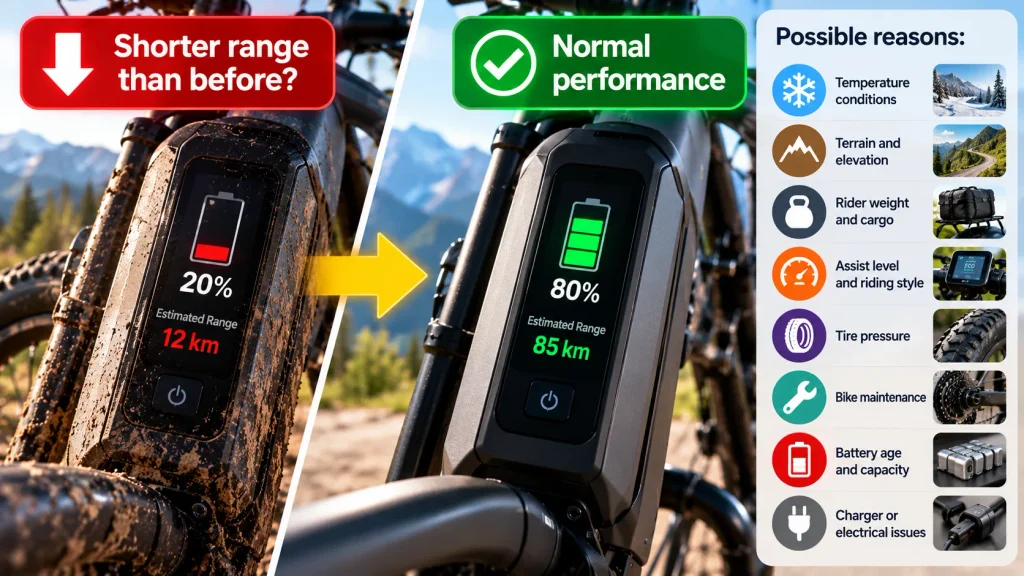
8. Don’t Ignore Changes in Battery Performance
A gradual reduction in range is normal as a lithium-ion battery ages. However, a sudden or unusually large change in performance deserves closer attention.
Several factors can affect your e-bike’s range:
- Ambient temperature.
- Rider weight and cargo.
- Terrain and elevation.
- Assistance level and riding speed.
- Tire pressure and mechanical condition.
- Battery age and remaining capacity.
- Charger, battery, or electrical-system faults.
Before concluding that your battery is worn out, compare rides under reasonably similar conditions.
For example, a shorter ride in cold weather with frequent steep climbs isn’t a reliable comparison with a longer summer ride on flat roads.
If the battery’s performance changes abruptly, the bike shuts down unexpectedly, or charging behavior becomes unusual, consult the manufacturer’s troubleshooting guidance or a qualified service provider.
Safety matters more than extending battery life. Stop using and charging a battery that is swollen, leaking, physically damaged, or unusually hot. Don’t open the pack or attempt cell-level repairs yourself. If it emits smoke or catches fire, move away and contact local emergency services.
9. Build a Simple Battery-Care Routine
You don’t need to monitor every battery parameter every day. A repeatable routine is usually more useful than complicated rules you can’t maintain.
Here’s a practical checklist to start with.
Use a compatible, approved charger.
[ ] Avoid routinely draining the battery to its cutoff.
[ ] Avoid prolonged storage at a very high or very low charge.
[ ] Keep the battery within its permitted temperature range.
[ ] Allow a cold battery to warm into its permitted charging range before charging.
[ ] Check the battery and charging equipment for visible damage.
[ ] Follow the manufacturer’s storage and maintenance instructions.
[ ] Investigate sudden changes in range or charging behavior.
E-Bike Battery Care Checklist
Your battery-care routine
0 of 8Use a compatible, approved charger.Avoid routinely draining the battery to its cutoff.Avoid prolonged storage at a very high or very low charge.Keep the battery within its permitted temperature range.Allow a cold battery to warm into its permitted charging range before charging.Check the battery and charging equipment for visible damage.Follow the manufacturer’s storage and maintenance instructions.Investigate sudden changes in range or charging behavior.
The checklist is a starting point, not a replacement for your bike’s manual. Battery chemistry, cell configuration, BMS behavior, and manufacturer requirements can all affect the correct maintenance procedure.
10. Know When to Charge to 100%
One of the most common sources of confusion in e-bike battery care is whether a full charge should be avoided altogether.
The answer is no.
Charging to 100% can be perfectly appropriate when you need the available range and your manufacturer permits it. The potential concern is leaving the battery at a very high state of charge for prolonged periods, particularly in warm conditions.
Consider these two scenarios:
Scenario A: Daily commuting
You use only part of your battery capacity for your commute and can recharge conveniently. A moderate charging routine may be practical if it aligns with the manufacturer’s instructions.
Scenario B: A long weekend ride
You need the battery’s full capacity to complete your planned route. Charging fully before departure makes sense, assuming the battery and charger are operating normally.
The right approach depends on your needs. Battery longevity and immediate range are related goals, but they aren’t always identical.
Rather than following a rigid percentage rule, understand when a charging recommendation applies and adjust it to your riding pattern.
Want a More Organized Approach to E-Bike Battery Care?
Battery care involves more than deciding when to plug in your charger. Charging habits, storage conditions, temperature, battery management, and the decision to charge fully all interact with one another.
If you want a more organized reference for everyday battery maintenance, Battery Bible Pro brings practical guidance on charging, battery health, BMS balancing, storage, and related topics together in one place.
It includes seven practical chapters, interactive battery tools, a PDF, and an online version. Future updates are included with the one-time $11 purchase, with no subscription.
Explore Battery Bible Pro here
Use it as a practical reference alongside your e-bike manufacturer’s instructions, not as a substitute for model-specific safety guidance.
Final Thoughts
Making your e-bike battery last longer isn’t about following one magic charging percentage. It’s about understanding the conditions that affect battery aging and building habits that fit your riding needs.
Start with the basics: use the correct charger, avoid routine deep discharges, manage heat and cold, store the battery sensibly, and charge fully when you genuinely need the range.
These habits can’t stop normal aging or guarantee a specific battery lifespan. They can, however, help you make more informed decisions about how you use and care for one of the most important components of your e-bike.