
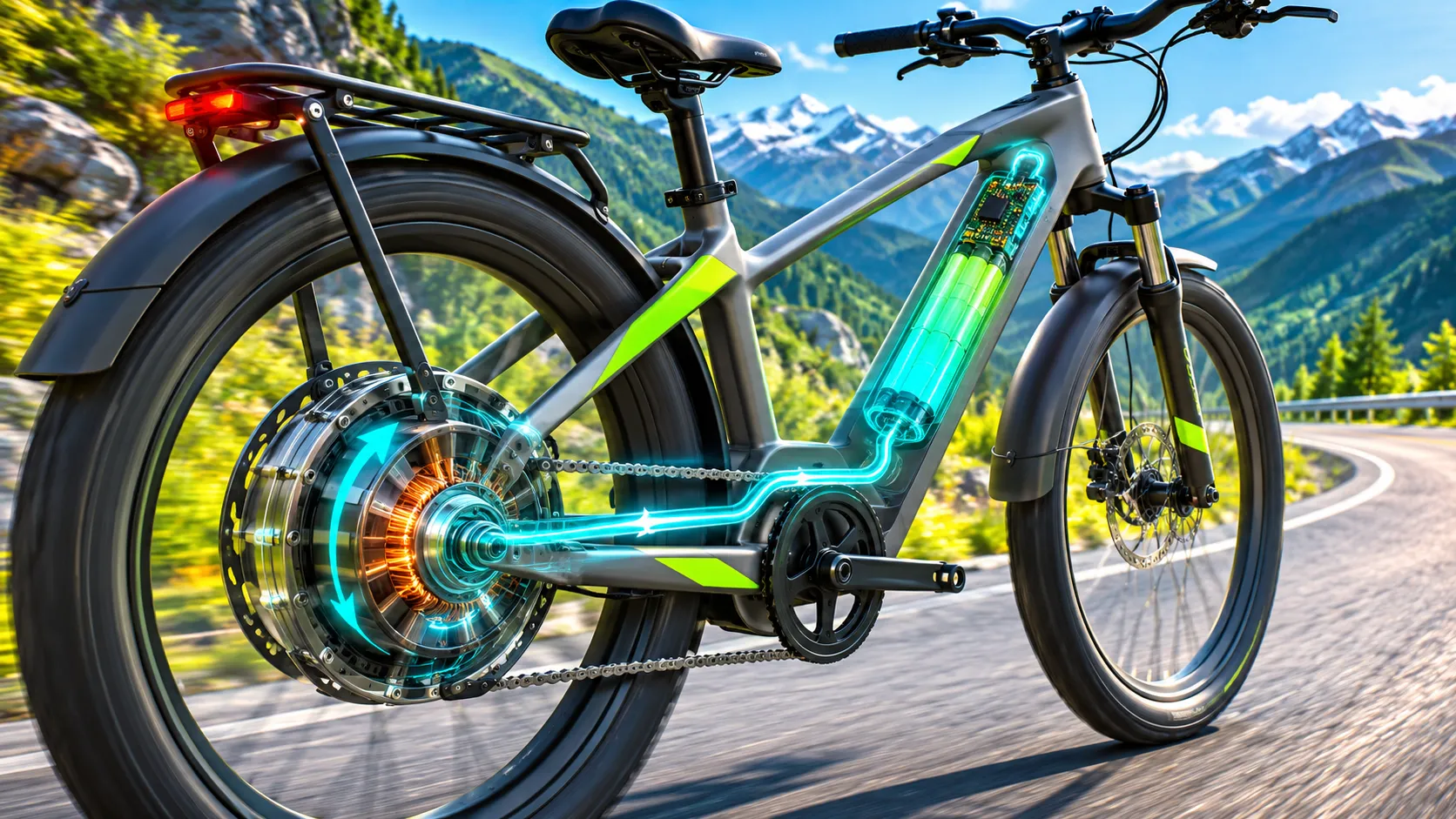
Imagine climbing a long hill on an electric bike. The motor has been drawing energy from the battery for several minutes. At the top, you turn around and begin descending. You stop pedalling, squeeze the brake levers, and the bike slows. The wheels are still turning, the motor is still connected to them, and the bike has kinetic energy that must go somewhere.
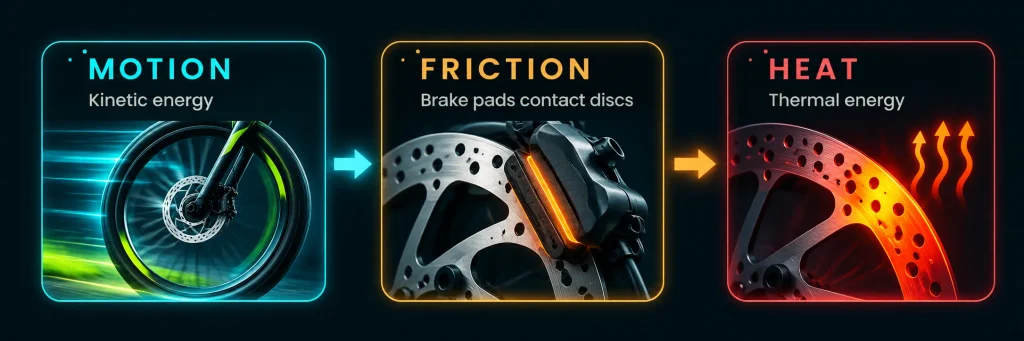
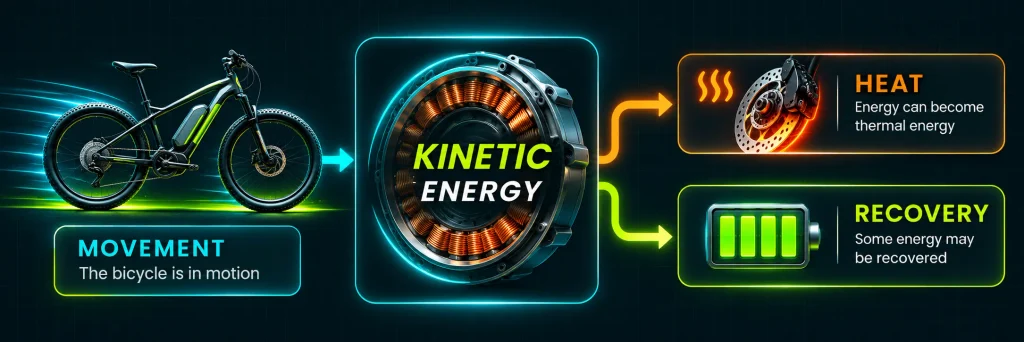
On an ordinary bicycle, most of that energy becomes heat in the brake pads and discs. On an e-bike equipped with regenerative braking, some of it can take a different route: from the moving wheel, through the motor and controller, back into the battery. For a moment, the motor behaves like a generator.
That sounds almost like getting energy for free. It is not. The recovered electricity comes from energy the bike already had because it was moving downhill or because the rider had accelerated earlier. Regeneration does not create energy; it changes where some of the energy goes when the bike slows down. And the amount that makes it back into the battery is usually much smaller than the energy that was available at the wheel.
This distinction is the key to understanding every regenerative-braking claim. The right question is not simply whether an e-bike can regenerate. It is how much of the bike’s available mechanical energy can pass through a chain of imperfect components, under the conditions in which the bike is actually ridden.
How a motor becomes a generator.
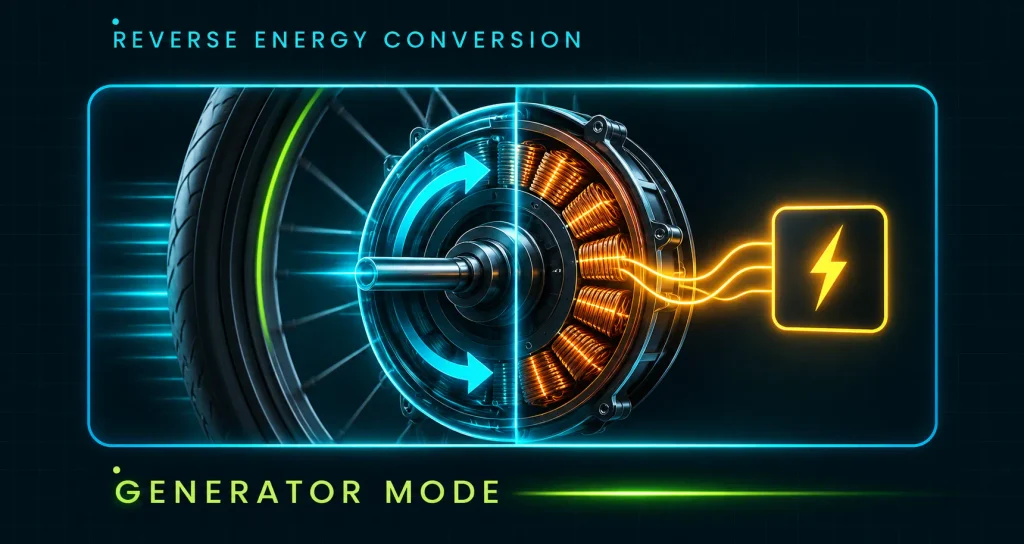
An electric motor and an electric generator are not fundamentally different machines. Both use the interaction between magnetic fields and electrical conductors. In motor mode, current in the windings creates magnetic forces that produce rotation. In generator mode, rotation moves the magnetic field relative to the windings, inducing a voltage. If the circuit allows current to flow into an electrical load, the machine resists the rotation and converts mechanical power into electrical power.
A useful mental model is a water pump that can also work as a turbine. When electrical energy drives the machine, it pushes the wheel around. When the wheel drives the machine, the machine pushes back electrically. The analogy is not exact—the motor relies on electromagnetic fields rather than flowing water—but it captures the reversible direction of energy transfer.
In a permanent-magnet motor, the rotating magnets sweep past the stator windings. This produces a back electromotive force, often shortened to back EMF. Its magnitude rises with motor speed. When the controller manages the phase currents so that electromagnetic torque opposes the wheel’s rotation, the motor produces braking torque and electrical power is generated.
The rider may experience this as a smooth drag that grows with speed or with the selected regeneration level. The exact feel depends on the motor design and the controller’s strategy. Regenerative braking is therefore not simply a motor that “spins backwards.” The wheel can continue turning in its normal direction while the electromagnetic torque acts against that motion. The controller changes how current flows; it does not need to reverse the physical direction of wheel rotation.
The generated electricity is not automatically suitable for charging a battery. Motor windings produce multiphase, changing electrical waveforms. The controller’s power electronics must manage those currents, convert the energy into a form the battery system can accept, and keep voltage and current within safe limits. This is why a motor that is physically capable of generating electricity does not, by itself, prove that a complete e-bike supports regenerative braking.
The energy path—and where it gets lost.
Follow the energy from the moving bicycle. First, the wheel turns the motor. Some mechanical energy is lost in bearings, seals, gears if present, magnetic effects and electrical resistance in the windings. The motor then produces electrical power, but the controller is not a perfect conductor. Its semiconductor switches, wiring and conversion stages introduce additional losses. Finally, the battery must accept the incoming current through its protection and management system, and energy is lost internally as the cells charge.
The result is a chain of conversion stages, each with an efficiency below 100 percent. If, purely as an illustrative example, the motor-generator stage is 85 percent efficient, the controller and wiring stage is 95 percent efficient, and the battery charging stage is 95 percent efficient, the combined efficiency is not 85 plus 95 plus 95. The efficiencies multiply:
0.85 × 0.95 × 0.95 ≈ 0.77
In this simplified example, about 77 percent of the mechanical energy entering the conversion chain reaches the battery as stored electrical energy. The remaining energy is dissipated mainly as heat and other losses. These percentages are illustrative assumptions, not a specification for any particular e-bike. Real efficiency varies with motor speed, torque, current, temperature, battery state of charge and controller design.
There is another important distinction: energy measured at the battery terminals is not necessarily identical to energy retained for later riding. Battery charging and discharging have their own losses. A display may show a small increase in state of charge, but state-of-charge estimates are rounded and filtered; a percentage indicator is not a laboratory energy meter. Watt-hours measured with suitable instrumentation provide a more meaningful comparison.
How much energy is actually available?
The first limit is the energy the bicycle has in the first place. A moving bike has kinetic energy. The faster and heavier it is, the more kinetic energy it carries. The basic relationship is:
Kinetic energy = ½ × mass × speed²
Mass is measured in kilograms and speed in metres per second. The result is joules; divide by 3,600 to convert joules into watt-hours.
Consider a combined bike-and-rider mass of 110 kilograms travelling at 25 kilometres per hour. That speed is about 6.94 metres per second. The kinetic energy is approximately 2,650 joules, or 0.74 watt-hours. Even if the bike could recover every joule—which no real system can—one stop from that speed contains less than one watt-hour of kinetic energy.
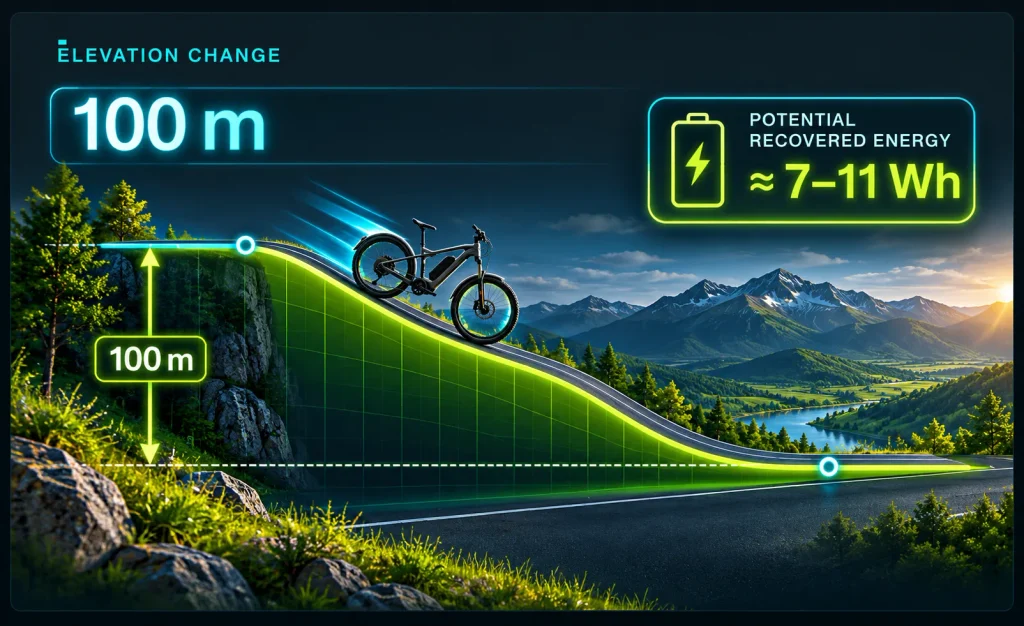
Now consider a descent. A 110-kilogram system descending 100 vertical metres loses gravitational potential energy equal to mass × gravitational acceleration × height. That is approximately 107,900 joules, or 30 watt-hours. This is a much larger energy reservoir than a single stop from urban speed. But the bike still cannot send all 30 Wh to the battery. Rolling resistance, aerodynamic drag, drivetrain losses, motor-generator losses, controller losses and battery charging limits all reduce the recoverable amount. Some of the energy may also be spent maintaining speed rather than braking, depending on the descent and the rider’s chosen pace.
These examples explain why regenerative braking is often more noticeable on long, sustained descents than in stop-start riding. A single traffic-light stop offers a small amount of energy. Repeating many stops can add up, but each event begins with a limited kinetic-energy budget. A long descent continuously replenishes the opportunity for regeneration as gravity pulls the bike downhill.
Speed matters strongly because kinetic energy rises with the square of speed. Doubling speed gives four times the kinetic energy, if mass is unchanged. But that does not mean it is sensible to ride faster to harvest more energy. Higher speed also increases stopping distance and crash severity, and aerodynamic drag grows rapidly with speed. Regeneration should be treated as a way to recover a fraction of energy that would otherwise be dissipated—not as a reason to create more braking energy.
Why many e-bikes cannot regenerate.
The most important hardware question is the motor architecture. Many common e-bikes use geared hub motors with an internal one-way clutch. The clutch allows the wheel to freewheel when the motor is not driving it. That is efficient and gives a natural coasting feel, but it also mechanically disconnects the wheel from the motor during coasting. If the wheel cannot drive the motor, the motor cannot act as a generator during that condition.
Direct-drive hub motors are generally better suited to regeneration because the wheel is mechanically coupled to the motor rotor. When the wheel turns, it turns the rotor. The controller can then command generator operation, provided the motor, controller, battery and wiring are designed for it. Some geared systems may have alternative designs or special coupling arrangements, so the label “hub motor” alone is not enough to establish compatibility.
Mid-drive motors present a different challenge. They transmit power through the bicycle’s chain and drivetrain. Many mid-drive systems use a freewheel mechanism so the pedals and motor can operate without forcing the rider’s legs to turn whenever the rear wheel moves. That one-way mechanical arrangement can prevent the rear wheel from driving the motor in the required direction for regeneration. The exact outcome depends on the drivetrain architecture, clutch arrangement and system design; it should not be assumed that a mid-drive can regenerate simply because its motor is electrically reversible.
A practical buying question is therefore not just “Does it have a powerful motor?” It is “Can the wheel mechanically drive this motor during deceleration, and does the complete electrical system support controlled energy return?” A manufacturer’s explicit regenerative-braking specification is more useful than a generic motor description.
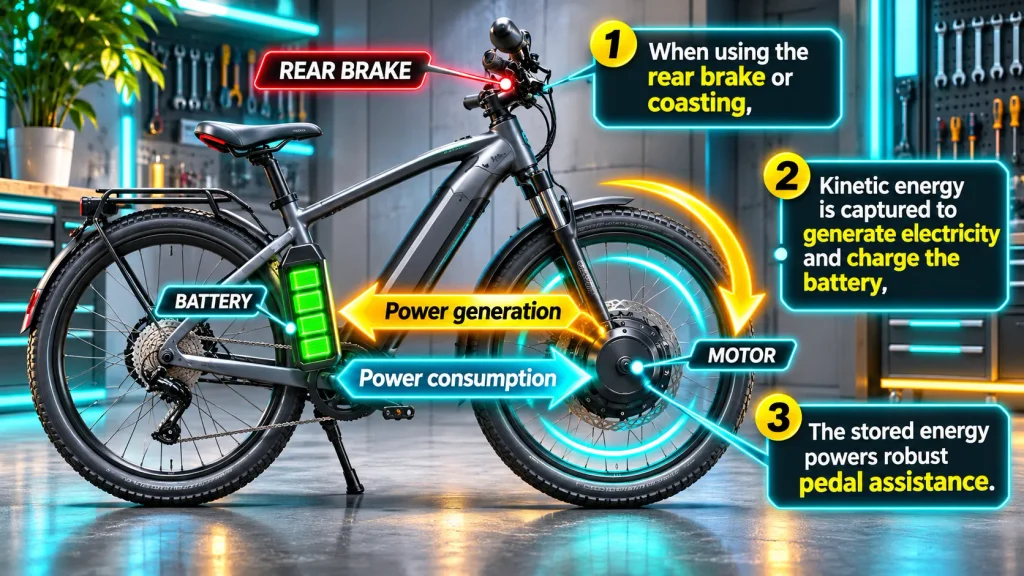
The battery and controller set the boundaries.
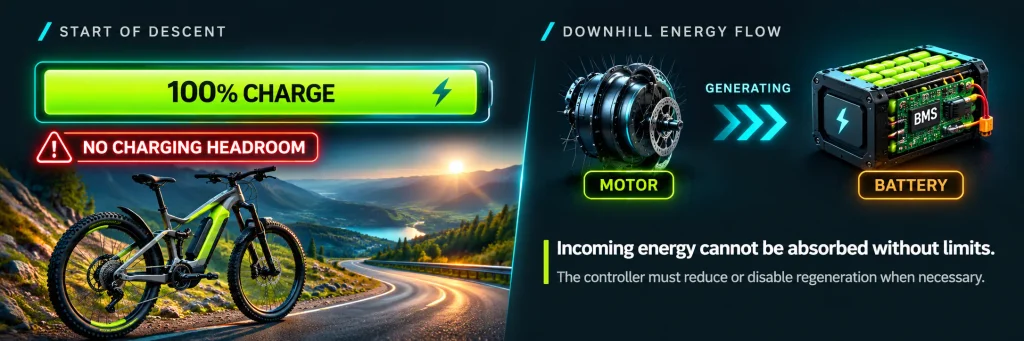
Even when the motor can generate electricity, the battery may not be able to accept it. Lithium-ion cells have limits on charging current, voltage and temperature. A battery near its maximum permitted state of charge has little or no room to accept additional energy. If the pack is cold, hot, aged or otherwise outside its allowed charging conditions, the battery-management system may restrict or block charging.
This creates an important downhill scenario. Imagine starting a mountain descent with a battery already at 100 percent. The motor may be capable of generating, but the battery cannot safely absorb unlimited incoming energy. A well-designed system must reduce or disable regeneration when the battery cannot accept the current. It must also provide a safe braking strategy that does not depend on charging being available. Regenerative braking is not a substitute for conventional mechanical brakes.
The controller has to coordinate motor phase current, battery-side current, voltage and temperature. It may impose a maximum regenerative current to protect the motor, switching devices, wiring and battery. It must also manage transitions so that braking feels predictable rather than abrupt. If the battery is full or protection limits are reached, the system needs to reduce regeneration and leave the rider with dependable friction brakes.
This is why compatibility is a system-level property. A direct-drive motor connected to an ordinary controller and an ordinary battery does not automatically become a regenerative system. The motor’s electrical characteristics, controller firmware and hardware, battery charge limits, BMS behaviour and braking controls all have to work together.
What practical efficiency looks like.
Suppose a rider repeatedly slows from 25 kilometres per hour to a stop. In the 110-kilogram example, the theoretical kinetic energy available is about 0.74 Wh per full stop. If the entire conversion path returned 60 to 75 percent of that energy to the battery under those operating conditions, the stored amount would be roughly 0.44 to 0.55 Wh per stop. That range is an illustrative scenario, not a measured universal efficiency. Ten similar stops might therefore return several watt-hours, assuming the system can regenerate during every event and the battery can accept the energy.
Against a 500 Wh battery, a few watt-hours are a small percentage. On a route with frequent stops, meaningful cumulative recovery is possible, but it is unlikely to transform the bike’s range. On a long descent, the energy opportunity can be larger. A 100-metre descent in the earlier example contains about 30 Wh of gravitational potential energy before losses. If a hypothetical complete system returned 60 to 75 percent of that amount, the battery might receive approximately 18 to 23 Wh. That is useful, but still only a few percent of a 500 Wh pack.
The real-world result depends on the route. A hilly commute with repeated descents can offer more recovery than a flat route. A heavy cargo e-bike descending a long hill has more gravitational energy available than a light bike on the same slope. But tyre pressure, wind, riding speed, surface, braking strategy, motor temperature, battery state of charge and system limits all influence the result. The same bike can recover different amounts on two rides that look similar on a map.
What regenerative braking is—and is not—good for.
The strongest case for regeneration is not necessarily maximum range. It can reduce the amount of work done by friction brakes during suitable descents, which may reduce brake-pad and rotor wear. It can also provide controlled deceleration and help manage speed on long downhill sections. Whether those benefits are significant depends on the system’s braking power, thermal behaviour and how the rider uses it.
There are trade-offs. A direct-drive hub motor may be heavier than a geared hub motor of comparable purpose, and it can create some magnetic drag even when not actively driving, depending on its design and controller state. Regeneration adds electrical and control complexity. It may require specific displays, brake sensors, controller firmware and battery compatibility. The system must remain safe when the battery is full, disconnected or unable to accept charge.
It is also important not to confuse regenerative braking with a conventional electronic brake cut-off. Many e-bikes cut motor power when a brake lever is pulled. That is not regeneration. A brake sensor that stops propulsion does not necessarily command generator torque or return energy to the battery. Likewise, a display that reports negative motor power does not prove that meaningful energy is being stored. The useful evidence is a documented system capability and, ideally, measured energy returned under clearly described test conditions.
How to judge a regenerative-braking claim.
When evaluating an e-bike, begin with the motor. Ask whether it is direct-drive or uses an internal freewheel, and whether the manufacturer explicitly supports regenerative operation. Then check the controller. It must be designed for energy return, not merely for forward propulsion. Look for a stated maximum regenerative current or power, the conditions under which it is available, and how the system behaves when the battery is full.
Next, examine the battery specifications. The pack must permit the relevant charging current and voltage, and the battery-management system must support the controller’s charging behaviour. A battery that can deliver a high discharge current is not automatically able to accept the same current while charging. Discharge and charge ratings are separate limits.
Finally, ask how performance was measured. “Up to 20 percent recovery” is incomplete without a route, starting speed, total mass, elevation change, battery state of charge, temperature and measurement method. A percentage can describe a particular downhill test, a theoretical model, or a comparison with a baseline that may not match everyday riding. Watt-hours returned over a defined route are more informative than a broad range claim.
For an owner, the safest approach is to use only the regenerative modes and settings supported by the bike’s manufacturer. Do not assume that an aftermarket controller, battery or display can be mixed into a regenerative system safely. Incorrect current paths, voltage limits or protection behaviour can damage components or create a loss of braking control. If regeneration behaves inconsistently, produces unexpected surges, or triggers battery or controller warnings, stop relying on it and have the system checked by a qualified service provider.
The honest answer.
So how much energy can an e-bike recover? There is no single percentage that applies to every bike or every ride. A full stop from ordinary urban speed contains less than one watt-hour for a typical rider-and-bike mass. A long descent can make tens of watt-hours of gravitational energy available. The amount actually stored is lower, sometimes substantially lower, because the motor, controller, wiring and battery all impose conversion losses and operating limits.
Regeneration works best when three conditions coincide: the wheel can drive the motor mechanically, the controller is built to manage generator operation, and the battery is able to accept the returned energy. Remove any one of those conditions and the energy path is interrupted or restricted.
The generator principle is elegant, but the practical lesson is simple. Regenerative braking does not make an e-bike self-charging, and it does not erase the energy cost of climbing a hill. It recovers a portion of energy that would otherwise become heat during deceleration. On the right route and with the right system, that portion can be worthwhile. On a flat commute with occasional stops, it is usually a modest bonus—not a range revolution.
References and further technical reading
- Bosch eBike Systems — technical information and product documentation on e-bike drive systems and braking functions
- Grin Technologies — Cycle Analyst and motor/controller technical resources, including regenerative braking discussions
- U.S. Department of Energy, Alternative Fuels Data Center — vehicle regenerative braking overview
- Battery University — BU-409: Charging Lithium-ion