Imagine climbing a steep street on an e-bike. The motor is in its highest assistance mode, the rider is pushing hard, and the bicycle is moving slowly. The chain is stretched tightly between the front chainring and a small rear sprocket. The rider presses the shifter. For a fraction of a second, the chain is asked to climb from one set of teeth to another while a powerful drive system is still pulling it forward. There is a sharp clack. The pedals jump. A few rides later, the chain begins to skip under acceleration.
It is tempting to blame poor-quality parts. Sometimes the parts really are underspecified. But often the deeper cause is the way an e-bike combines human power, motor assistance, gearing and shifting. An electric motor does not simply make every part of the bicycle stronger. It changes the forces and the situations in which those parts operate.
That distinction matters. A drivetrain can survive thousands of smooth gear changes and still wear quickly if it repeatedly experiences high torque at low cadence, dirty lubrication and abrupt shifts. The aim is not to treat every e-bike as fragile. It is to understand where the extra load comes from, and how to manage it.
Torque is not the same thing as power.
The first source of confusion is the number printed on a motor specification sheet. A motor advertised with 85 newton-metres of torque is not necessarily delivering 85 newton-metres directly to the chain at every moment. The number describes torque at a defined point in the drive unit and under specified operating conditions. The relationship between motor torque and chain force depends on the motor architecture, internal reduction gearing, chainring size, gear ratio and control system.
Torque is a twisting force. Power is the rate at which work is done. For rotation, the relationship is:
Power (watts) = Torque (newton-metres) × Angular speed (radians per second).
This explains an important feature of electric assistance. A motor can produce substantial torque at relatively low rotational speed without producing its maximum power. When a rider accelerates from a slow speed or climbs a steep hill in a high gear, the system can apply a strong twisting force while the drivetrain turns slowly. That is a demanding operating condition for the chain and sprocket teeth.
A useful way to picture the chain is as a row of small steel links transmitting force around two toothed wheels. The chain does not experience a vague quantity called “motor power”. It experiences tensile force along its length, plus local contact forces where rollers engage sprocket teeth. If the force rises, the load at those contacts rises too. If the chain is poorly aligned, dirty, worn or engaging only a small number of teeth effectively, the conditions become less forgiving.
The rider contributes to this load as well. On a mid-drive e-bike, the motor and rider feed power into the bicycle’s chain-driven transmission. Their contributions combine at the crank or chainring system. The chain therefore carries the combined output, not just the rider’s leg power. On a hub-motor e-bike, by contrast, the motor drives the wheel through the hub and does not send its propulsion torque through the bicycle chain. The chain still carries the rider’s pedalling force, but the motor’s wheel-driving torque largely bypasses the chain. This is why “e-bikes wear chains faster” is too broad a statement unless the motor layout is specified.
Why low cadence and a hard gear can be a bad combination.
Consider two ways to climb the same hill. In the first, the rider selects an easier gear and spins the pedals at a relatively high cadence. In the second, the rider stays in a hard gear, turns the cranks slowly and asks for maximum assistance. Both may produce similar forward speed, but the drivetrain does not experience the same operating pattern.
In the hard gear, the chainring and rear sprocket relationship requires a different chain force to deliver the same wheel-driving torque. The motor may also be operating at a low cadence where it can deliver strong torque. The chain is pulled hard while the rider’s pedal stroke and motor control can create fluctuating loads. A smooth, sustained climb becomes a sequence of high-force events if the rider repeatedly accelerates, eases off and accelerates again.
Selecting an easier gear generally allows the crank and motor input to turn faster for a given road speed. It can reduce the torque required at the crank for a given wheel torque, although the exact chain tension depends on the chainring, sprocket and transmission geometry. The practical lesson is not “always use the smallest rear cog” or “always spin as fast as possible”. It is to choose a gear that lets the motor and rider operate smoothly, without lugging the system at very low cadence.
Cadence is the number of crank revolutions per minute. It is not a magic protection number, and the ideal range varies by motor, rider, terrain and system design. But an e-bike that labours slowly in a high gear is often placing more stress on its transmission than one that climbs in a suitable lower gear with a steady pedalling rhythm.
The shift: a brief moment with very high consequences.
A derailleur changes gears by moving the chain sideways from one sprocket to another. The chain must climb, release and re-engage with teeth whose positions and shapes are designed to guide that transition. Under light pedalling pressure, this is a controlled movement. Under heavy torque, the chain is being pulled tightly against the teeth at the same time that it is being forced sideways.
That combination can create a harsh shift. The chain may hesitate before climbing, strike the next sprocket, or engage abruptly. The shift pins, ramps and shaped teeth help modern drivetrains change gear, but they do not make every high-load shift harmless. Shimano’s technical material on LINKGLIDE specifically addresses the shock and wear associated with high-torque e-bike use, while its broader guidance notes that riding and shifting under torque can reduce drivetrain performance.
The most useful habit is simple: ease the pressure briefly as the shift happens. On a mid-drive e-bike, this may mean a short reduction in pedal force and, where the system supports it, allowing the motor assistance to soften during the shift. Shift before the steepest part of the climb, not halfway through a maximum-effort acceleration. If the bike has electronic shifting or an automatic system, understand what the software actually does; do not assume every system removes all drivetrain load.
This is also why starting in an unnecessarily hard gear is punishing. The first crank rotations can combine a high motor contribution, a heavy rider push and low cadence. Downshift before coming to a stop when practical, then accelerate in a gear that allows the system to turn freely. Smoothness is not merely comfort. It is a way of reducing peak loads.
How a chain wears—and why the cassette follows.
A bicycle chain is often described as “stretching”. The steel side plates do not normally elongate like a rubber band. What increases is the effective pitch of the chain as the pin-and-bushing or pin-and-inner-link interfaces wear. Tiny amounts of material are lost at many joints. Added together across the chain, those clearances make the chain behave as if it has become longer.
A chain with increased pitch no longer seats perfectly on the cassette teeth. Instead of sharing load across the intended contact pattern, it can ride higher on the teeth and concentrate force in the wrong places. The cassette then wears to match the elongated chain. If a new chain is installed on a badly worn cassette, the new chain may not mesh correctly and can skip under load. That is why replacing a chain early can save the more expensive cassette and chainring.
Wear is not caused by tension alone. Chain joints articulate every time they pass around a sprocket. Friction occurs inside the joints and where rollers engage the teeth. Abrasive contamination makes the situation worse. Dust, grit and road grime mix with lubricant to form a grinding paste. Poor lubrication increases friction and accelerates material loss; excess lubricant left on the outside can attract more dirt. The goal is a clean, appropriately lubricated chain, not a chain covered in sticky oil.
Chainline matters too. When the chain runs at an extreme angle across the cassette, side plates and sprocket surfaces experience additional lateral friction and stress. Cross-chaining is especially relevant on wide-range drivetrains. A gear combination that is technically selectable is not necessarily the most efficient or durable choice for sustained high-load riding. A recent review of bicycle drivetrain tribology describes the effects of misalignment, friction at chain joints and sprocket contact, contamination and dynamic loading. These mechanisms help explain why maintenance and gear choice work together rather than independently.
Why the cassette can fail before the chain looks finished.
The cassette is not just a collection of metal teeth. Its sprockets are shaped to guide the chain during shifts, and their tooth profiles are designed around a specific chain width, speed count and shifting system. Smaller sprockets have fewer teeth in contact with the chain at any instant and rotate more times for a given distance travelled. Under high torque, a small sprocket can therefore be a particularly demanding place to transmit force.
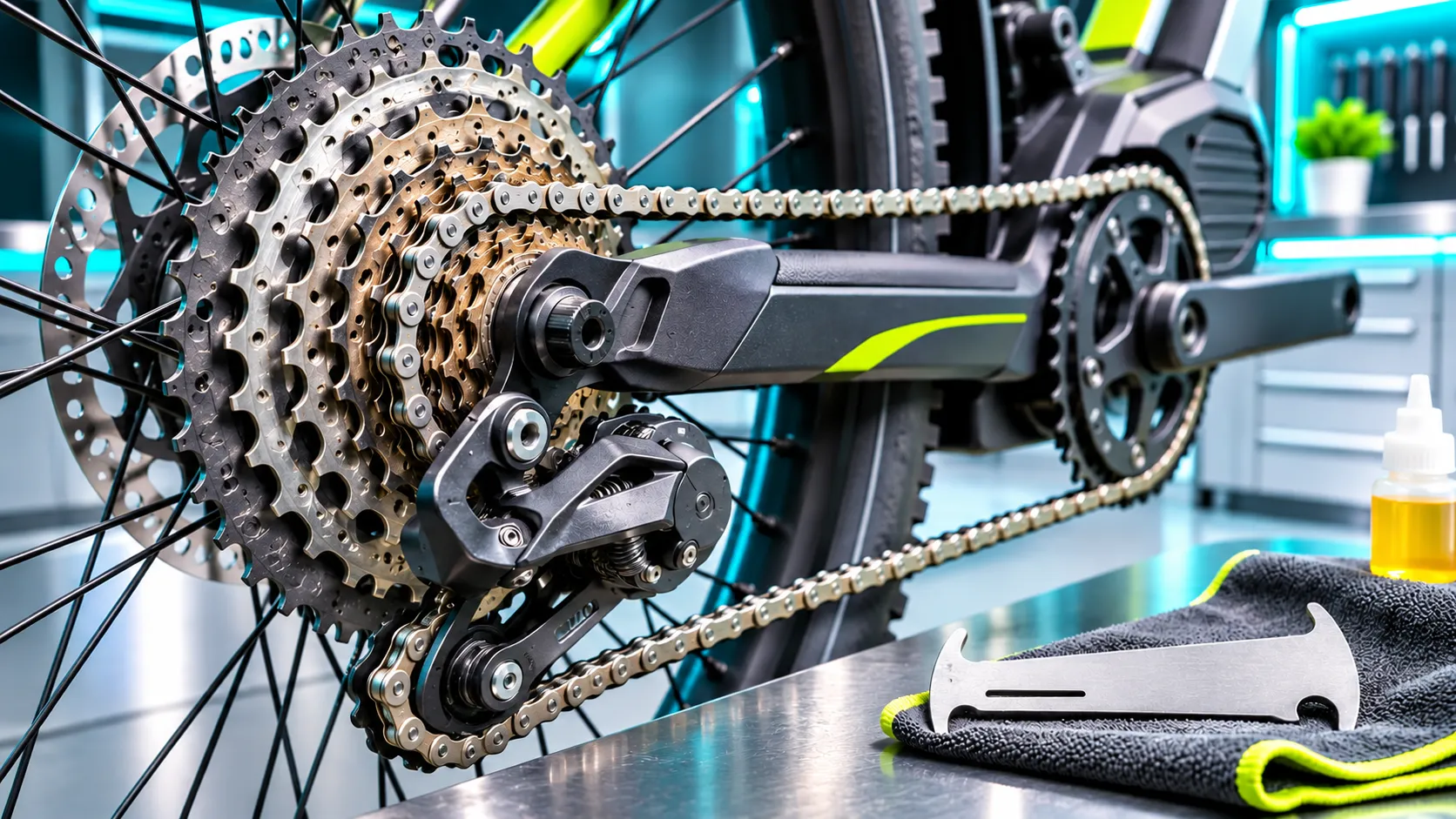
A worn cassette often reveals itself as chain skipping under load, especially in the gears used most often. The teeth may look hooked or uneven, but visual inspection alone is not always conclusive because modern sprockets deliberately use different tooth shapes for shifting. A chain wear gauge and a controlled assessment by a competent mechanic are more reliable than judging every tooth by appearance.
The chain, cassette and chainring wear as a system. Replacing only one part may be correct when the others remain within service limits; replacing several together may be necessary when wear has become matched. SRAM’s Eagle Transmission documentation, for example, specifies a chain replacement threshold of 0.8% elongation for that system and warns that continued use beyond the threshold can contribute to system failure. That figure should not be treated as a universal limit for every chain. Always follow the measurement threshold specified by the chain or drivetrain manufacturer, especially on narrow multi-speed chains where the correct gauge and measurement method matter.
Why some e-bike drivetrains last longer.
Not all drivetrains are designed for the same duty cycle. A lightweight road-oriented system, a high-range mountain-bike cassette and a utility e-bike drivetrain may share the same basic chain principle while making different compromises in weight, shifting speed, gear range and durability.
E-bike-specific systems can use stronger chains, more robust sprocket profiles, revised shift ramps or different gear spacing. Shimano LINKGLIDE is one example. Shimano describes it as a durable system intended for daily use and high-torque e-bikes, with thicker cassette teeth and revised shifting geometry. The company states that CUES with LINKGLIDE can provide up to three times the durability of its conventional HYPERGLIDE system in e-bike use. That is a manufacturer claim tied to its comparison and test conditions, not a promise that every rider will obtain exactly three times the service life.
A durable drivetrain is not automatically compatible with every e-bike. Cassette, chain, derailleur, shifter, freehub body, chainline and motor-system requirements must match. Shimano’s compatibility documentation makes clear that e-bike configurations have specific component combinations and restrictions. A cassette that physically fits the wheel may still be unsuitable for the rest of the system.
There is also a motor-layout decision. A mid-drive uses the bicycle’s gears, allowing the motor to benefit from the gear ratio but exposing the chain and cassette to the combined rider-and-motor load. A hub motor bypasses the chain for motor propulsion, which can reduce motor-related drivetrain stress, but it introduces other trade-offs involving wheel mass, heat management, gearing efficiency and climbing behaviour. Neither layout is universally superior. The correct comparison depends on the riding conditions and the way the bicycle is used.
A maintenance routine that changes the economics.
The cheapest drivetrain is not necessarily the one with the lowest purchase price. The useful figure is the cost per kilometre over the life of the chain, cassette and chainring, including labour and the inconvenience of unexpected failure. A modest maintenance routine can change that equation.
After wet or dusty rides, clean the chain and drivetrain before contamination becomes a persistent abrasive layer. Use a bicycle-appropriate cleaner and lubricant, following the product instructions. Apply lubricant to the chain’s moving interfaces, allow it to penetrate as directed, and remove excess from the outside. The outer surface should not be wet and sticky with surplus oil. Shimano’s maintenance guidance recommends checking chain wear regularly, cleaning and relubricating the chain, and inspecting the cassette, chainring and derailleur pulleys.
Measure chain wear at intervals appropriate to mileage and conditions. High-torque e-bike use, muddy riding and frequent climbing justify more frequent checks than occasional dry-path riding. Use a gauge compatible with the chain type and follow the drivetrain maker’s replacement threshold. Do not wait until the chain visibly skips. At that stage, the cassette may already have suffered avoidable wear.
Pay attention to symptoms. A new clicking sound under load, shifting that becomes inconsistent, a chain that skips on one or two favourite sprockets, or visible damage after a shift deserves inspection. A bent derailleur hanger, worn chain, damaged teeth or incorrect adjustment can produce similar symptoms. Do not keep applying maximum motor assistance to a drivetrain that is skipping. A chain failure under load can cause loss of control, and damaged components should be assessed before the next ride.
Cleaning is not an invitation to use a high-pressure washer on bearings, motor seals or hub mechanisms. Water forced past seals can create a separate reliability problem. Follow the bicycle and component manufacturers’ cleaning instructions, and use a qualified workshop when the fault involves motor interfaces, damaged structural parts or a drivetrain that repeatedly fails despite correct adjustment.
The riding technique that saves the most metal.
The most effective drivetrain protection begins before the chain makes a sound. Look ahead. If a steep ramp is coming, shift to an easier gear while the load is still moderate. Avoid accelerating hard from a standstill in the highest gear. On a climb, choose a gear that keeps cadence smooth rather than forcing the motor to labour. When shifting, briefly reduce pedal pressure so the chain can move across the cassette without fighting maximum torque.
Avoid prolonged use of extreme chain angles when a more aligned gear is available. Keep the chain clean, lubricated and within its wear limit. If the bike has a configurable assistance profile, remember that higher assistance can mean higher component wear as well as greater energy consumption. Bosch explicitly notes that higher performance settings can increase wear and reduce range. More assistance is not free; it moves the operating point of the whole system.
These habits do not eliminate wear. Chains and sprockets are consumable parts, and e-bikes can accumulate distance quickly. They do, however, reduce avoidable shock loads and prevent a worn chain from quietly consuming a cassette. A rider who understands load and timing can often get more useful life from the same components without sacrificing the reason they bought an e-bike in the first place.
The real answer: the motor does not destroy the drivetrain—load management does.
An e-bike drivetrain wears faster when its components repeatedly transmit high force in unfavourable conditions. Mid-drive motor torque adds to the rider’s input. Low cadence and hard gearing can increase the force required through the chain. Shifting under heavy torque forces the chain to move sideways while it is tightly loaded. Dirt and poor lubrication accelerate wear inside the chain joints and at the sprocket interface. Once chain pitch increases, the cassette begins to suffer too.
That is the full chain of cause and effect. It is more useful than blaming a motor’s advertised torque number in isolation. Torque matters, but so do gear ratio, cadence, motor control, chainline, component design, cleanliness and the rider’s timing.
The strongest e-bike drivetrain is therefore not simply the one with the thickest-looking chain or the most expensive cassette. It is a matched system used in a way that respects its load limits. Shift before the climb becomes brutal. Let the motor spin in a suitable gear. Ease pressure during gear changes. Keep abrasive dirt out of the chain joints. Replace the chain at the correct wear threshold, before it turns a relatively inexpensive service item into a cassette-and-chainring replacement.
The quietest drivetrain is often telling you something important: the rider, motor and gears are working together instead of fighting each other.
References and further technical reading
- Shimano — Spring Cleaning and Maintenance (drivetrain inspection, chain wear, cleaning and lubrication)
- Shimano — LINKGLIDE technology (durability design for high-torque e-bikes)
- Shimano — DEORE XT and DEORE with LINKGLIDE Technology (high-torque shifting and wear context)
- SRAM — Eagle Transmission User Manual (chain replacement threshold and e-MTB wear notice)
- Bosch eBike — Performance Upgrade (higher performance, wear and range trade-offs)
- Power Transmission Mechanism and Tribological Performance of Modern Bicycle Drivetrains—A Review, Machines, 2025
- SHIMANO — 2026–2027 Product Compatibility Information (e-bike drivetrain compatibility)