
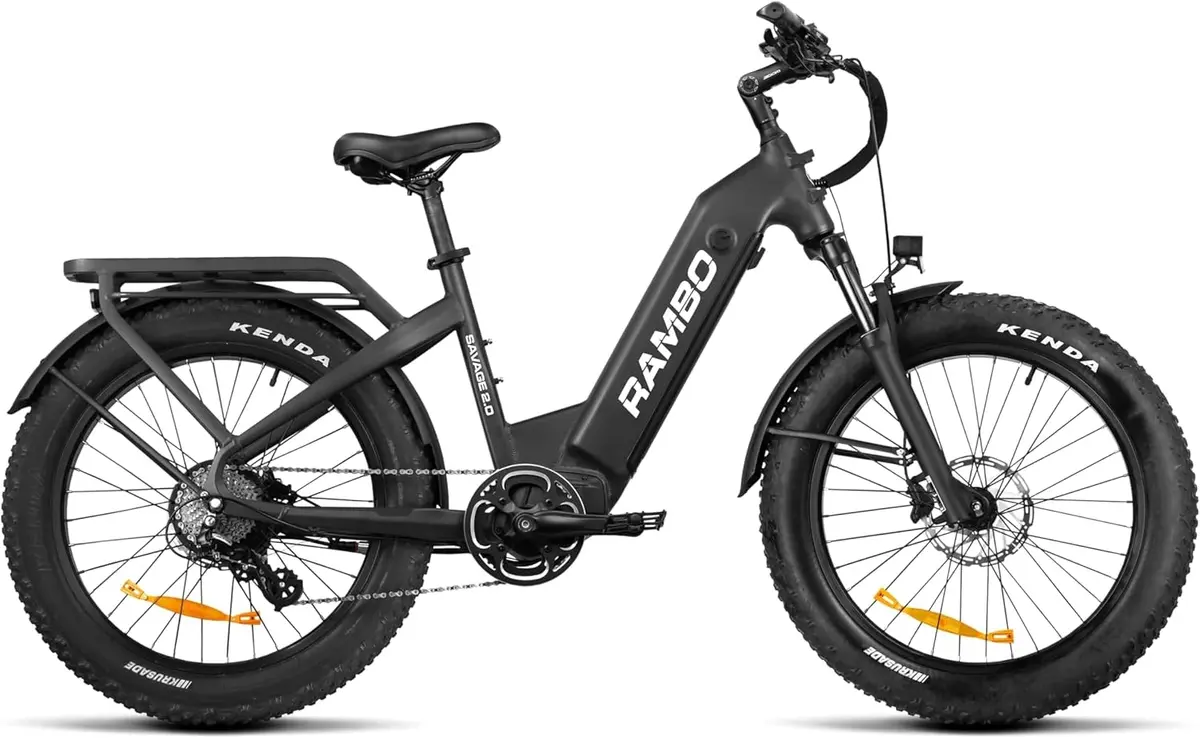
I’m staring at a 20% grade on a muddy access trail in the Ozarks, and I’m not even touching the pedals yet. The Rambo Savage 2.0 isn’t trying to be a sleek city commuter; it’s a blunt instrument designed to haul 300 lbs of gear and rider into places where cell service goes to die. Within the first mile, it becomes clear that this is a “tractor” in a world of “sport sedans.” The 24-inch wheels give it a lower center of gravity than the standard 26-inch fat bikes, making it feel remarkably planted when the trail gets greasy. This bike is built for one thing: getting a hunter or an adventurer to the back-of-beyond without spooking every living thing within a five-mile radius.
Contents
Frame, Geometry and Build Quality
The heart of the Savage 2.0 is a hydroformed 6061 T6 aluminum frame that feels like it was welded in a tank factory. Rambo went with a step-through design here, and I initially worried it would feel “noodly” under stress. It doesn’t. The tubing is thick, and the reinforcement at the step-through point keeps the frame stiff even when I’m standing on the pedals.
By using 24-inch by 4-inch Kenda tires instead of the massive 26-inchers found on the Rambo Rebel, the Savage 2.0 drops the standover height significantly. This is a massive win for practicality. When you’re wearing heavy boots and a pack, or if you have a trophy buck on a trailer behind you, swinging a leg over a high top tube is a recipe for a tip-over. The weight distribution is centered, though at 71 lbs fully dressed, it’s a beast to lift into a truck bed. The battery is tucked low into the downtube, which helps keep the front end from feeling “floppy” on technical climbs.

Power and Drivetrain (The Heart of the Bike)
This is where the marketing fluff ends and the physics begins. Rambo markets this as a 750W to 1000W system, but what actually matters is the 90 Nm of torque and the 1200W peak output. I found the motor engagement to be surprisingly smooth for a hub drive. It doesn’t have the jerky “all-or-nothing” feel of cheaper hub motors. Instead, it offers a linear surge of power that’s vital when you’re trying to maintain traction in loose leaves or mud.
The drivetrain is a Shimano 8-speed with an 11-32T range. While some purists might want a mid-drive for technical rock crawling, this high-torque Bafang hub motor actually protects your drivetrain. You won’t be snapping chains or shearing derailleur hangers under the motor’s 90 Nm of force because the power goes directly to the rear wheel. The Adjustable Class System (ACS) is the secret sauce here; I can toggle between Class 1, 2, or 3 via the display. If I’m on a multi-use trail, I lock it to Class 1. If I’m on private land and need to get back to camp before a storm hits, I unlock the full 30 mph potential.
The Competition: Real World Alternatives
If you’re cross-shopping the Savage 2.0, you’re likely looking at the Lectric XPeak 2.0 or the QuietKat Pioneer.
- Against the Lectric XPeak: The Lectric is the value king and offers a more refined “user interface,” but it feels like a toy compared to the Rambo when you’re off-road. The Rambo’s frame is significantly beefier, and its 90 Nm of torque out-muscles the Lectric on sustained climbs. You pay a “hunting tax” for the Rambo, but you get a bike that won’t rattle itself to pieces on a washboard fire road.
- Against the QuietKat Pioneer: The Pioneer is a worthy rival, but the Savage 2.0 feels more accessible due to that step-through frame and the 24-inch wheels. QuietKat often wins on “cool factor,” but Rambo wins on the sheer variety of hunting-specific accessories like their game carts and gun scabbards that integrate perfectly with the Savage’s rack.
Limitations and The Bitter Truth
Let’s get real: the Logan two-piston hydraulic brakes are the weak link. While they provide decent stopping power, they feel a bit “mushy” when you’re descending a steep grade with a full load. For a bike that can hit 30 mph and carry a 300 lb payload, I really wanted to see four-piston calipers here.
The “Bitter Truth” is the range. Rambo claims up to 48 miles, but in my real-world testing—using a mix of throttle and high-level assist on hilly terrain—you’re looking at more like 22 to 28 miles. If you’re planning a deep backcountry mission, the optional dual-battery setup isn’t just a “nice to have,” it’s a necessity. Also, while the motor is “whisper quiet” compared to a gas ATV, it’s not silent. On a still morning, you can definitely hear the whir of the planetary gears from about 50 yards away.

The Final Verdict: Buy or Skip?
Buy this if… You are a hunter or backcountry explorer who needs a rugged, dependable “mule.” The step-through frame makes it the most practical bike in the Rambo lineup for anyone wearing bulky gear or those who want a more stable, lower-to-the-ground ride. It’s the sweet spot in the 2026 market for power versus price.
Skip this if… You’re looking for a “mountain bike” feel. This is a utility vehicle. If you want to “flick” the bike around corners or jump logs, you’ll find the 71 lb weight and fat tires cumbersome. If you’re a city commuter, the Kenda fat tires are overkill and will produce a loud hum on asphalt that will drive you crazy.