

I was grinding up a broken asphalt climb that quickly disintegrated into loose, chunky gravel, waiting for that familiar jarring vibration to shoot up my wrists, when I realized something strange. My hands weren’t numb, my rear tire wasn’t slipping, and I was holding the exact same pace I usually reserve for pristine tarmac.
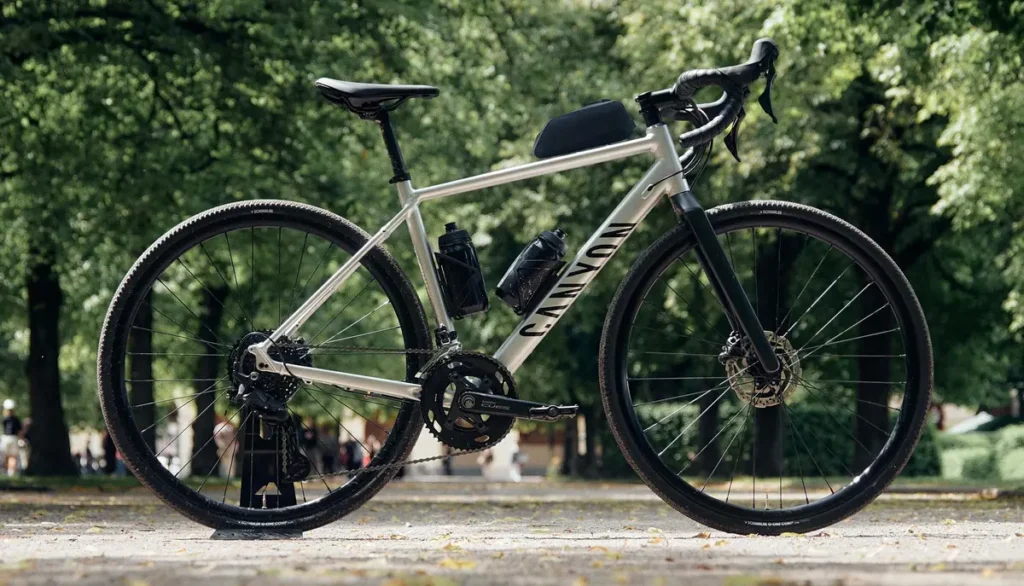
This is the Canyon Endurace Allroad. It costs $1499, and there is one very specific engineering choice on this machine that completely shattered my expectations of what an aluminum road bike can handle. But it also introduces a massive compromise that might make it completely the wrong tool for your local group ride.
I will explain exactly who should stay far away from this bike in a few minutes, right after we break down how it actually handles the rough stuff.
FIRST IMPRESSIONS & DESIGN
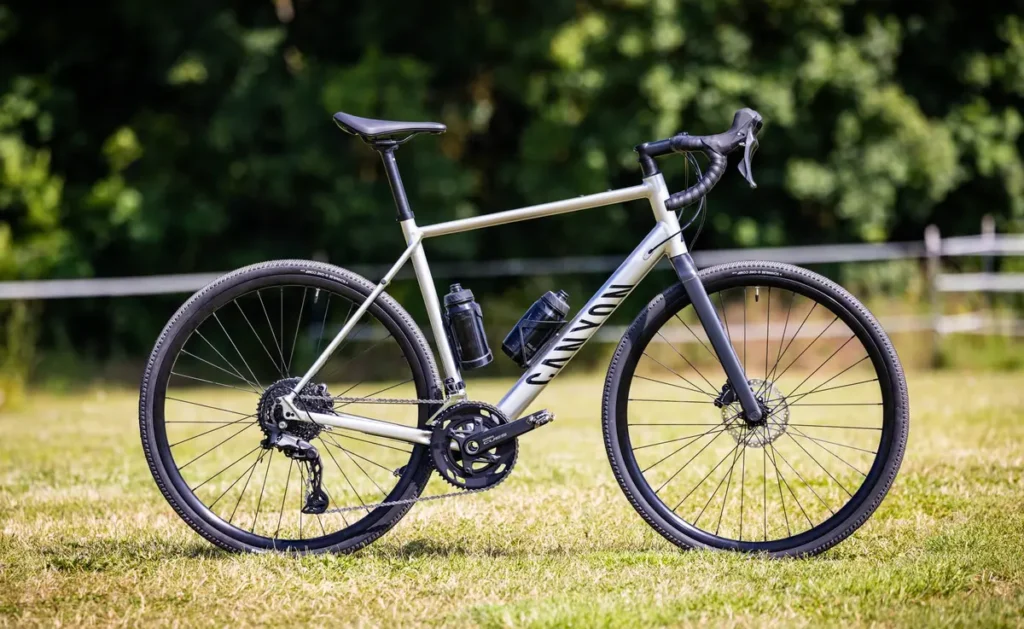
Pulling this bike out of the box, the first thing that hits you is the execution of the frame. This is aluminum, but Canyon uses highly manipulated 6061-T6 tubes with incredibly smooth welds. If you aren’t looking closely at the bottom bracket or the dropouts, you could easily mistake it for a modern carbon frame. The paint has a deep, matte finish that feels premium and looks rugged enough to handle flying gravel debris.
When I lifted it up, my scale registered exactly 8,9 kilograms for this Size Large without pedals. Now, let’s keep that in perspective. It feels noticeably lighter than any dedicated gravel bike or budget hardtail mountain bike you might use for mixed-terrain riding, but it carries a penalty of about a kilogram over pure carbon endurance road bikes in this exact price bracket.
But here is what surprised me: Canyon did not chase a featherweight spec sheet. Instead, they put that weight exactly where it matters for long-term durability and versatile performance. They gave us an incredibly robust DT Swiss wheelset and massive tire clearance.
Looking closely at the frame design, the cable routing enters cleanly through the downtube with tight rubber grommets that keep water and grit out. You also get integrated top tube mounts for a bolt-on fuel bag, which is a massive nod toward all-day adventure riding. It is clear that this bike isn’t trying to win a local hill-climb time trial. It is a machine built to take a beating on terrible roads and keep you comfortable while doing it.
FRAME & GEOMETRY: HOW IT FEELS
To understand this bike, we have to look at Canyon’s endurance geometry philosophy. On a Size Large, you are looking at a stack height of 611 millimeters and a reach of 387 millimeters. When you compare that to a traditional race bike, it places your torso in a much more upright, relaxed position.
In practical terms, this means when I spent four hours in the saddle, my lower back and neck weren’t screaming at me. The front wheel is pushed slightly further forward, and the chainstays are long enough to provide a stable, predictable platform.
Let me give you a specific ride scenario where this geometry choice completely alters the experience. I was descending a fast, winding asphalt backroad at 55 km/h when the surface suddenly switched to chattered, broken pavement with mid-corner potholes. On a traditional, twitchy race geometry bike with a steep head tube angle, that transition forces your heart into your throat. You are constantly fighting the handlebars to keep the bike from deflecting off line.
On the Endurace Allroad, the longer wheelbase and stable front end simply tracked straight through the chaos. It filters out that nervous energy, giving you the confidence to stay off the brakes and maintain your momentum.
However, this stability comes with a distinct trade-off. This is where the geometry choice really matters: when I took this bike onto tight, twisty paved switchbacks that required rapid, snappy direction changes, the Endurace felt a bit deliberate. It requires more deliberate body language and a heavier lean to carve a tight arc compared to a sharp-handling race bike. If you want a bike that snaps across the lane the microsecond you think about it, this stable geometry will feel sluggish to you.
COMPONENTS
DRIVETRAIN & SHIFTING
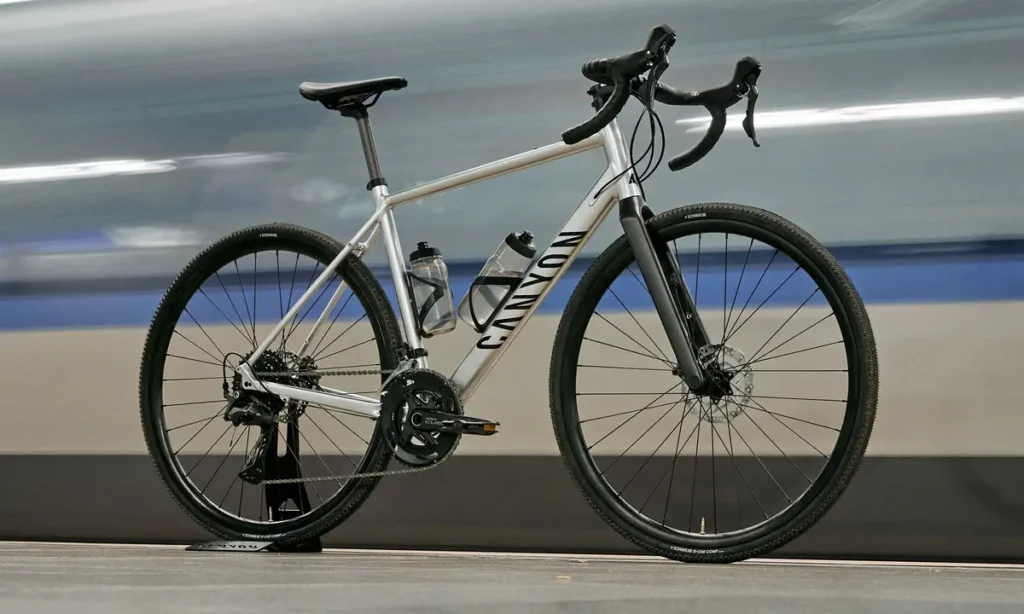
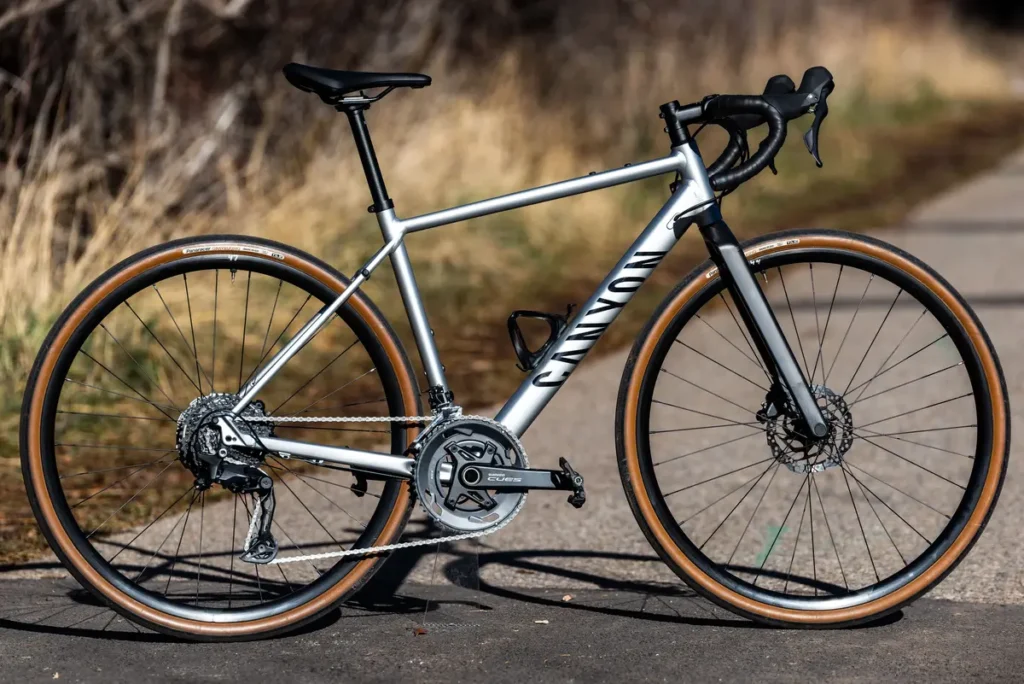
Canyon did something highly unusual here for an all-road bike: they bypassed standard road components and specced a full Shimano GRX RX820 12-speed gravel groupset. You get a 48/31 tooth sub-compact chainring up front paired with an 11-36 tooth 12-speed cassette in the back.
In real-world terms, this setup changes everything on steep terrain. That 31-tooth small chainring paired with the 36-tooth cog gives you a sub-one-to-one climbing gear. I was able to spin comfortably up a brutal fifteen percent loose gravel wall while staying seated, keeping my heart rate out of the red. On a standard road bike with a traditional compact crankset, you would be out of the saddle, mashing the pedals, and fighting for traction.
The shifting performance under heavy load was impeccably crisp. Shimano’s GRX mechanical levers have a redesigned braking pivot and a textured hood shape that gives your hands a secure purchase even when covered in sweat or road grime.
The clutch mechanism on the GRX rear derailleur completely eliminates chain slap, which kept the drivetrain dead silent when I was bouncing over broken fire roads.
The trade-off here is on the top end. If you are rolling down a gentle descent with a howling tailwind at over 50 km/h, you will spin out that 48-11 top gear much faster than you would on a standard 50 or 52-tooth road chainring. It is a configuration that prioritizes surviving steep terrain over winning high-speed road sprints.
BRAKES & CONTROL
Stopping power is handled by Shimano GRX RX820 hydraulic calipers clamping down on 160-millimeter Shimano RT-CL800 rotors both front and rear. These calipers utilize Shimano’s mineral oil system, which is far more user-friendly for home mechanics compared to corrosive DOT fluids.
I truly tested these brakes on a sustained, high-speed descent that dropped 300 vertical meters over 3 kilometers, riddled with sharp, loose corners. The modulation on these levers is incredibly refined. Instead of a grabby, on-off sensation that easily locks up a tire on loose dirt, you can feather the power with a single finger, feeling exactly when the tire is on the verge of breaking traction.
The 160-millimeter rotors provided excellent heat dissipation. Even at the bottom of the descent, when the rotors were hot to the touch, I noticed zero brake fade or lever migration.
The minor downside is that the pads can get quite noisy if you plunge through wet, gritty mud puddles, emitting a temporary metallic squeal until the rotors wipe themselves clean. But in terms of pure stopping confidence, this setup is flawless.
SUSPENSION PERFORMANCE (RIGID FORK)
Up front, this bike uses Canyon’s proprietary FK0086 CF carbon fiber disc fork. Now, this is a fully rigid bike—there are no mechanical shocks or micro-suspension elements built into the frame.
I set my tire pressure carefully and headed straight into a flat section of road filled with harsh, stuttering frost heaves. A high-quality carbon fork is engineered to flex microscopic amounts fore and aft while remaining completely rigid laterally for precise steering. The Canyon fork did a brilliant job of taking the sharp edge off those repetitive, high-frequency vibrations. It transforms what would be a violent, tooth-chattering buzz on a cheap aluminum fork into a dull, manageable thud.
But let’s be entirely realistic about the performance limits. When I hit a sunken pothole with a sharp t3-cm vertical edge at speed, the fork hit its mechanical threshold. There is no air spring or oil damper here to compress, so that energy traveled straight through the handlebars and into my wrists.
For all-road riding, cracked asphalt, and smooth dirt, this carbon layup is exceptionally well-tuned. But do not mistake this for a cross-country mountain bike; if you take it down deeply rutted tractor paths, you will quickly find the limits of a rigid frontend.
WHEELS & TIRES
The bike rolls on a set of DT Swiss Endurance LN aluminum wheels wrapped in 35-millimeter Schwalbe G-One Speed Evolution tires, set up tubeless straight out of the box. The wheels feature a modern 22-millimeter internal rim width, which allows the wide tires to seat perfectly without creating a squirmy, lightbulb-shaped profile.
The Schwalbe G-One Speed tires are the defining feature of the entire “Allroad” package. They feature a low-profile, dimpled tread pattern that offers incredibly low rolling resistance on smooth pavement. They hum quietly on fresh asphalt, rolling almost as fast as a standard 28-millimeter racing tire.
However, when I veered off the pavement onto hardpack dirt and fine gravel, those dimples bit into the terrain beautifully, allowing me to corner with genuine confidence.
The tubeless setup is an absolute lifesaver. I ran these tires at roughly three bar of pressure, which allowed the casing to deform over rough stones, creating a massive contact patch and absorbing immense trail chatter.
The trade-off here is mud performance. If your route includes wet clay or deep, greasy mud, this minimal tread packs up instantly and turns into a slick. This is an all-road tire built for dry gravel and pavement, not a sloppy cyclo-cross track.
COCKPIT & COMFORT
The contact points feature a 420-millimeter wide Canyon H17 Ergobar aluminum handlebar paired with a 100-millimeter Canyon V13 stem. The handlebar has a subtle, ergonomic sweep on the tops, which gives your palms a flat, comfortable surface to rest on during long, arduous climbs.
The bar tape is Canyon’s Ergospeed gel, which provides a thick, tacky grip that buffers hands against road buzz.
The saddle is a Selle Italia Model X. It has a modern, short-nose design with a prominent central relief channel. On rides under two hours, the flex in the eco-friendly plastic shell felt incredibly supportive.
However, on a long, four-hour testing block, the sticky surface material of the saddle created a bit of friction against my bib shorts, which led to a few warm spots. Saddles are incredibly subjective, and while this is a durable piece of gear, it may be the first thing you swap out if it doesn’t match your specific anatomy.
REAL-WORLD TESTING: THE RIDE
CLIMBING PERFORMANCE
I took the Endurace Allroad to a local loop that features a brutal, undulating climb starting on asphalt and finishing on a rough forest track, averaging a ten percent gradient with pitches hitting eighteen percent.
When climbing while seated on smooth asphalt, the frame feels remarkably stiff. The aluminum bottom bracket area doesn’t flex or waste your energy when you put power into the pedals. The efficiency is highly impressive, and the bike claws its way upward with a composed, steady rhythm.
The real magic happens when the road surface deteriorates. On a regular road bike, hitting a patch of loose gravel on an eighteen percent pitch forces you to stand up to keep momentum, which often unweights the rear tire and causes it to spin out uselessly. On this bike, because of that ultra-low GRX gearing and the wide 35-millimeter tire, I could stay firmly planted in the saddle, keep my center of gravity over the rear wheel, and simply spin my way up the loose debris without a single slip.
The only downside is sheer mass. When the gradient stays steep for multiple kilometers, you do feel those extra eight hundred grams compared to a pure carbon climbing rig. It won’t stop you from conquering the mountain, but it will take a few more seconds of sustained effort.
DESCENDING CONFIDENCE
Descending on this bike is an absolute joy. I pointed it down a steep, winding alpine fire road filled with loose stones and sudden washboards.
The frame geometry and wide tires make it feel incredibly stable. Even when hitting rough patches at forty-five kilometers per hour, the bike never skipped or danced unpredictably beneath me. The powerful GRX brakes meant I could delay my braking points until right before the corner, knowing exactly how much traction I had available.
I hit one deep, unexpected ridge across the dirt track at speed. The tire compressed, the carbon fork flexed, and the bike rode straight through it without bottoming out the rim or knocking me off balance. It gives you a sensation of total control that makes you want to hunt down the worst roads in your county just to see how fast you can ride them.
HANDLING & AGILITY
On tight, singletrack path shortcuts and narrow lanes, the bike shows its true colors. The longer wheelbase means it prefers wide, sweeping arcs over razor-sharp, instantaneous cuts.
I found myself having to lean my body weight into the turn a fraction of a second earlier than I would on a standard road bike to hit my apex perfectly. It is a very safe, predictable handling characteristic that prevents beginners from over-correcting, but experienced racers might find it a bit uninspiring in a tight criterium pack.
COMFORT & VIBRATION
Let me share a quick micro-story that perfectly sums up this bike. I was about three hours into a grueling mixed-surface ride, crossing a long, flat valley floor into a brutal headwind. The road was covered in chip-and-seal pavement—the kind of surface that creates a high-frequency buzz that vibrates straight through your shoes, saddle, and handlebars, slowly wearing down your stamina.
My riding partner, who was on a classic carbon road bike with twenty-five millimeter tires pumped up to seven bar, was constantly shifting positions, shaking out his numbing hands, and visibly suffering from the physical toll of the road.
Meanwhile, I was comfortably tucked into the drops of the Endurace. The combination of the 35-millimeter Schwalbe tires running tubeless at lower pressures and the dampening properties of the carbon fork and gel tape completely neutralized that high-frequency chatter.
My hands were perfectly fine, my core felt fresh, and I was able to put down steady power while my friend was systematically beaten up by the terrain. That is the real-world benefit of an all-road setup that you simply cannot read on a standard spec sheet. It preserves your energy by filtering out physical fatigue.
UNEXPECTED STRENGTHS
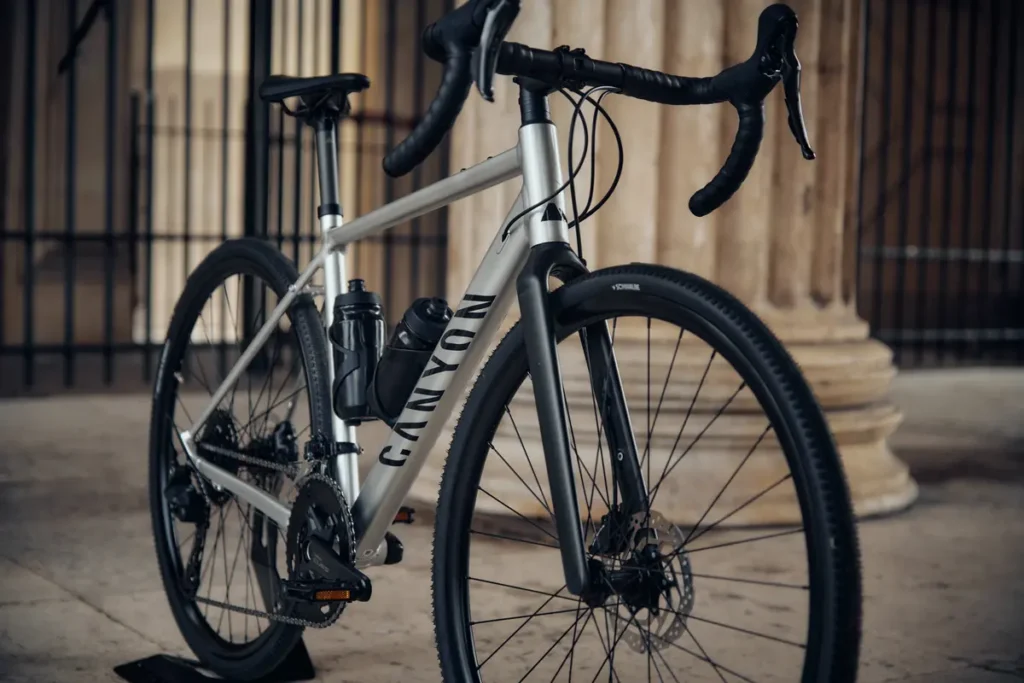
What Canyon doesn’t shout about in their main marketing bullets is the sheer versatility of the wheel and tire clearance. While the bike comes equipped with 35-millimeter tires, the frame is officially rated to clear up to 38-millimeter tires with room to spare. This means if you decide you want to transition this bike into a dedicated, light gravel machine for the winter, you can throw on a set of aggressively knobby gravel tires and completely transform its capabilities.
Another unexpected strength is the durability of the DT Swiss Endurance LN wheelset. These aren’t exotic, lightweight racing wheels, but the build quality is phenomenal. Over my weeks of testing, I accidentally smashed into several hidden rock edges and blasted through deep potholes that should have easily dented an alloy rim or knocked it out of alignment.
When I put the bike up on the repair stand at the end of my testing block, both wheels were still spinning absolutely dead true, with perfect spoke tension. Canyon wisely chose components that stand up to real-world abuse over components that merely look good on a digital scale.
THE COMPETITION: REAL-WORLD ALTERNATIVES
When I compare the Canyon Endurace Allroad to its closest rivals in this price category—specifically the Trek Domane AL 5 and the Specialized Allez Sprint Comp—the choices become crystal clear.
The Trek Domane AL 5 costs roughly the same amount and also features an aluminum frame with wide tire clearance. However, Trek specs the Domane with a standard Shimano 105 road drivetrain. The Shimano 105 groupset offers tighter gear steps which are brilliant for maintaining a perfect cadence on pristine asphalt, but it completely lacks the clutch mechanism of the GRX derailleur and doesn’t offer that ultra-low, sub-one-to-one gear ratio for steep gravel walls. The Trek is a road bike that can occasionally handle dirt; the Canyon is an all-road bike that genuinely embraces it.
The Specialized Allez Sprint Comp sits at a higher price point and takes a completely different, highly aggressive approach. It features an aerodynamic aluminum frame optimized for pure, raw speed, sharp handling, and crit racing. It has incredibly tight tire clearance and a stiff, unyielding ride quality.
If your goal is to go as fast as humanly possible for an hour around a smooth, paved circuit, the Specialized will absolutely demolish the Canyon. But if you try to ride that Specialized down a rugged, unpaved backcountry lane, your teeth will shake loose within the first ten minutes.
You are essentially choosing between the Trek for a more traditional, road-biased endurance experience, the Specialized for pure asphalt speed and aggressive racing, or the Canyon Endurace Allroad for the ultimate balance of durability, low gearing, and mixed-terrain freedom.
THE HONEST ASSESSMENT: TRADE-OFFS AND COMPROMISES
WHAT IT DOES EXCEPTIONALLY WELL
This bike absolutely nails the promise of endless exploration. The combination of an incredibly tough aluminum frame, highly compliant carbon fork, powerful GRX hydraulic brakes, and low gravel gearing means you can string together routes that would be impossible on a standard road bike. It bridges the gap between tarmac speed and dirt capability flawlessly, maintaining a comfortable, fatigue-reducing ride quality over hours of abuse.
WHERE IT FALLS SHORT
Here is the reality that Canyon’s marketing won’t emphasize: the weight and the gear steps are a real compromise on structured group rides.
Because Canyon chose a gravel-focused 11-36 tooth cassette to give you those massive climbing gears, the jumps between the individual gears are quite large. On flat, fast roads where a peloton is moving at a steady thirty-eight kilometers per hour, you will often find yourself in a situation where one gear forces you to spin an uncomfortably high cadence of ninety-five revolutions per minute, but shifting up one cog drops your cadence down to a sluggish seventy-five revolutions per minute. You are constantly hunting for a middle gear that simply does not exist on this cassette.
For individual exploration, solo training, and mixed-terrain commuting, this doesn’t matter at all. But if your primary goal is to join fast, tightly packed weekend club road rides where matching the exact pace of a smooth paceline is critical, you will find this drivetrain layout highly frustrating.
To work around this, you would need to buy a secondary, tighter road cassette like an 11-30 tooth and a set of narrower 28-millimeter road tires for asphalt-only days, which adds a few hundred dollars to your initial investment and requires tools to swap back and forth.
Remember at the start when I mentioned there is one component choice that makes this bike brilliant for some but completely wrong for others? Here it is:
The inclusion of the full Shimano GRX gravel groupset gives this machine its identity. It makes the bike an absolute tank on steep hills and rough roads, but those wide gear steps completely rob it of the smooth, precise cadence adjustments that high-speed asphalt road racers require.
WHO IT’S FOR / NOT FOR
This bike is FOR:
Riders who live in areas with terrible, cracked pavement, chip-and-seal backroads, or extensive network of dirt and gravel paths, who want to ride fast without fearing potholes.
The solo adventurer who values all-day structural comfort, long-term frame durability, and highly reliable components over saving a few hundred grams.
Commuters who need a lightning-fast utility machine that can handle wet weather, mount a top tube bag, and shrug off daily road hazards without constant maintenance.
This bike is NOT FOR:
Pure road purists who want to participate in fast, competitive group rides, local amateur road races, or fast pacelines where tight gear steps are required to maintain a perfect cadence.
Weight-weenies who obsess over climb times and want the absolute lightest carbon machine possible for smooth tarmac ascents.
Riders looking for a dedicated trail bike; if your routes consist of deep mud, loose sand, and technical singletrack, you should skip this and buy a dedicated gravel bike or a hardtail mountain bike instead.
FINAL VERDICT: BUY OR SKIP
Buy this bike if:
- You have two thousand dollars to spend and want a highly capable machine that completely removes the boundary between paved roads and dirt tracks.
- You want an incredibly reliable Shimano GRX groupset with a clutch and a low climbing gear that allows you to spin up steep walls without breaking traction.
- You want a comfortable, upright endurance geometry that preserves your body on all-day mixed-surface epic rides.
Skip this bike if:
- Your primary riding consists of pristine asphalt and fast, competitive group rides where the large gear jumps of a gravel cassette will constantly leave you out of your ideal cadence zone.
- You are looking for a razor-sharp, instantaneous handling race machine that snaps through corners at a crit track.
The Canyon Endurace Allroad is a bike that makes one clear statement: freedom of route choice matters far more than marginal weight savings. If your riding style involves pointing your front wheel down an unknown road regardless of what it’s made of, this bike offers exceptional value.