
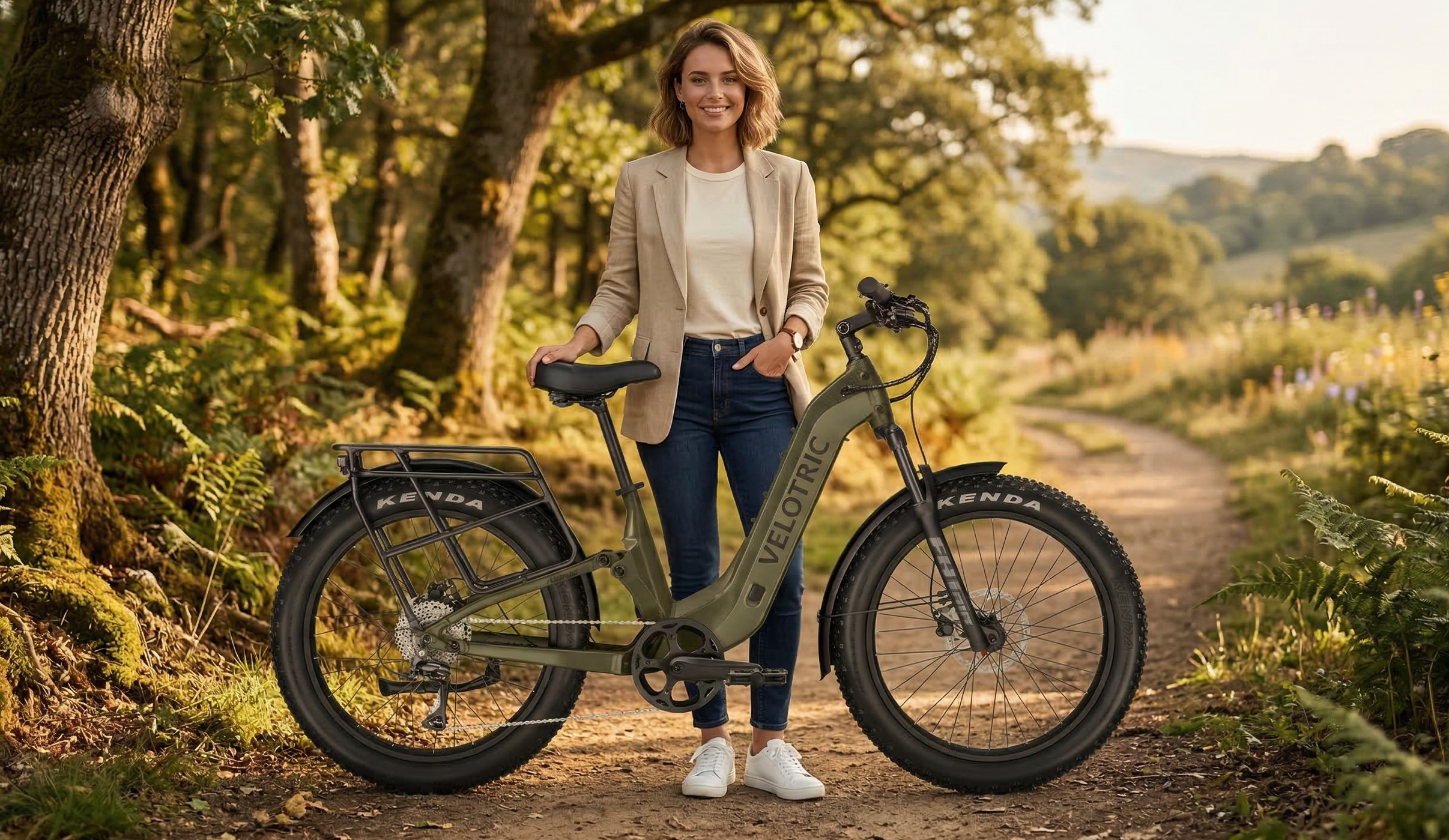
I rolled the Summit 2 out onto a local fire road that averages a 12% grade, exactly the kind of terrain that makes or breaks a hub motor. Within the first quarter mile, I realized this isn’t just a commuter with knobby tires. The way the power engages as soon as I put pressure on the pedals—not after a half-turn of the cranks—immediately set a high bar. It feels eager. This bike is built for the rider who wants to explore “green” rated mountain bike trails on Saturday but needs to haul a laptop and groceries on Monday. It is a Class 2 machine out of the box, meaning it has a throttle and caps at 20 miles per hour, but I easily unlocked it to Class 3 through the Velotric app to hit those 28 miles per hour sprints on the asphalt.
Frame, Geometry and Build Quality
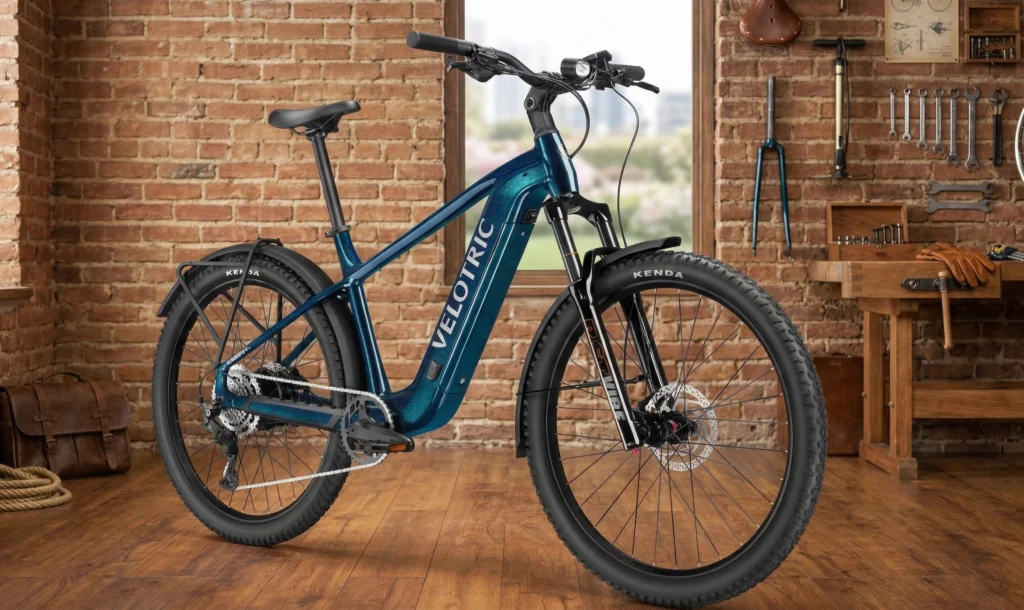
The Summit 2 uses a triple-butted aluminum frame that feels remarkably stiff under heavy pedaling. One thing I noticed right away is the improved geometry over the original model. They have tucked the battery deeper into the downtube, which keeps the center of gravity lower and makes the 63 pound total weight (with fenders and kickstand) feel much more manageable when leaning into a corner.
The standover height is generous, which I appreciated when I had to dab a foot down on a technical uphill section. However, I found the reach to be a bit long for a “hybrid.” Luckily, Velotric included an adjustable stem this year. I was able to angle it up to save my lower back on the long road ride home, though a true mountain biker might find the front end a bit “busy” with all those adjustment points. The addition of an RST Vibe air suspension fork with 120 millimeters of travel is the real hero here. Unlike cheap coil forks that just pogo around, I was able to tune the air pressure to my exact weight. It soaked up stutter bumps and small roots without that harsh “clunk” on the rebound.
Power and Drivetrain (The Heart of the Bike)
This is where the Summit 2 earns its “Summit” name. The 750 watt rear hub motor peaks at a massive 1300 watts and delivers 100 Newton meters of torque. In the world of hub motors, 100 Newton meters is a lot of punch. When I hit the throttle from a dead stop, the “violence” of the acceleration is noticeable; it doesn’t lag or groan.
The most impressive part of the electronics is the “Sensor Swap” technology. I spent most of my time in the torque-sensing mode because it makes the bike feel like an extension of my own legs. If I push hard, the motor gives me everything. If I’m just spinning, it stays quiet. If you prefer the “moped” feel where you just ghost-pedal, you can switch it to cadence-sensing mode in the settings.
For the mechanical side, they went with the Shimano CUES 9-speed system. This is a huge upgrade from the old Altus or Acera parts we used to see. The 11-46 tooth cassette is wide enough that I could actually contribute to the climb on steep grades without the motor doing 100% of the work. Even under the high torque of the 750 watt motor, the shifts remained crisp and didn’t produce that terrifying “metal-on-metal” pop you get with cheaper drivetrains.
The Competition: Real World Alternatives
I can’t talk about the Summit 2 without mentioning the Aventon Ramblas. The Ramblas is a true mid-drive e-mountain bike. If your goal is 80% dirt and 20% road, the Ramblas is the better tool because the mid-drive motor handles technical climbing and weight balance far better than a hub motor ever will. However, the Ramblas is significantly more expensive and lacks a throttle.
On the budget side, you have the Lectric XPeak. The Lectric is much cheaper and offers a similar “big power” feel, but it feels like a tank in comparison. The Summit 2 is more refined, has better suspension, and the Shimano CUES shifting is leagues ahead of the entry-level components on the Lectric. You are paying the extra few hundred dollars for the air fork and the sophisticated torque sensor.
Limitations and The Bitter Truth
The Summit 2 is a fantastic hybrid, but it is not a “hardcore” mountain bike. The biggest issue I found was the pedal strikes. The bottom bracket feels a bit low for 27.5 inch wheels, and I clipped my pedals on several rocks that a dedicated mountain bike would have cleared with ease.
Then there is the “Bitter Truth” of the rear hub motor. Because most of the weight is in the back wheel, the bike feels “tail-heavy” when you try to lift it over an obstacle or a curb. If you get a flat tire on the trail, removing that rear wheel with the motor wire is a headache you don’t want. Also, while the Shimano MT200 hydraulic brakes are reliable, I felt them starting to fade slightly toward the bottom of a 1000 foot descent. For a bike this heavy and powerful, I would have loved to see 203 millimeter rotors instead of the standard 180 millimeter ones.
The Final Verdict: Buy or Skip?
Buy this if… You want one bike that can do everything. It is powerful enough to conquer any paved hill in San Francisco, yet robust enough to handle weekend gravel adventures and light singletrack. If you value a throttle but still want a bike that feels natural to pedal, this is currently the best value in the “SUV” e-bike category for 2026.
Skip this if… You are a dedicated mountain biker looking to hit jumps or technical “black diamond” trails. The rear-heavy weight distribution and low pedal clearance will frustrate you. Also, if you have a very short commute on flat ground, the 100 Newton meters of torque is total overkill—you could save 500 dollars and 10 pounds by going with a lighter city commuter.